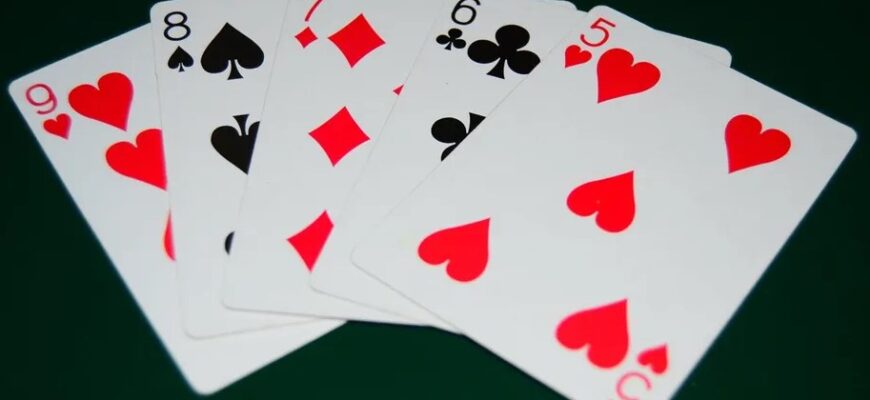
When studying poker, it’s crucial not only to know the name, components, and strength of each hand but also to understand how to leverage it in different game situations. In this article, we’ll dive into the poker hand “straight,” which ranks sixth in strength among the ten possible combinations. Although it’s not the strongest hand, it often becomes the winning one, capturing a significant portion of the pots.
But beware—the straight has its own set of hidden risks, which we’ll explore further below.
Definition and Characteristics of a Straight
Let’s start with a basic question: what is a straight in poker? A straight is a combination of five cards in consecutive rank order. For example, 4-5-6-7-8 is a straight from 4 to 8, where the cards follow each other in sequence without any gaps.
The suit doesn’t matter in a straight, meaning all five cards can be of different suits. If you manage to line up five cards in sequence, all in the same suit, it’s called a straight flush—one of the most powerful hands in the game, ranking just below the royal flush.
A straight can be formed by multiple players in a single hand. When that happens, the strength of each straight depends on the highest card in the sequence. Logically, the straight with the ace as the top card is the strongest. However, this only applies when the ace acts as the highest card.
Interestingly, in a straight, the ace can function as either the highest or lowest card. The high version is 10-J-Q-K-A, but beginners may find the low version (A-2-3-4-5) confusing. Here, the ace is treated as a one.

Important: No other combination involving an ace, such as K-A-2-3-4, counts as a straight.
So, in poker, an ace-involved straight can be the strongest or the weakest. The lowest straight, A-2-3-4-5, is often referred to as the “wheel” since it cycles between the highest and lowest cards.
Ways to Form a Straight
In Texas Hold’em, a straight can be made from your hole cards and the community cards on the table. Generally, the more hole cards used to form the straight, the stronger and more promising the hand becomes for potential profit. Straight is no exception. Let’s look at the various ways to form a straight in poker.
Straight on the Board. Sometimes, the straight appears directly on the board, leading many new players to assume the pot will be split. But one or more players could still have a higher straight thanks to a high card in their hand. For instance, if the board shows 5-6-7-8-9, someone holding 10-J would have a higher straight.
One Hole Card, Four from the Board. Using one hole card and four community cards is another way to make a straight, though it’s not as strong. If your hole card completes the lower end (like a 5 in a 6-7-8-9 straight), it’s likely a weaker hand. Higher straights will win in such cases.
Filling a Gap with a Hole Card. If one hole card closes a gap in the sequence (like a 3 completing 2-4-5-6), the hand has solid potential. For an opponent to beat this, they’d need cards like 3-7 or 7-8, which lowers their chances. It’s even better if your hole card completes the high end, like a 10 in 6-7-8-9.
Using Both Hole Cards. The best way to form a straight is by using both hole cards, making the hand more unpredictable. Opponents won’t easily expect you to hold two cards that complete the sixth-strongest hand. This can be used to maximize the pot.
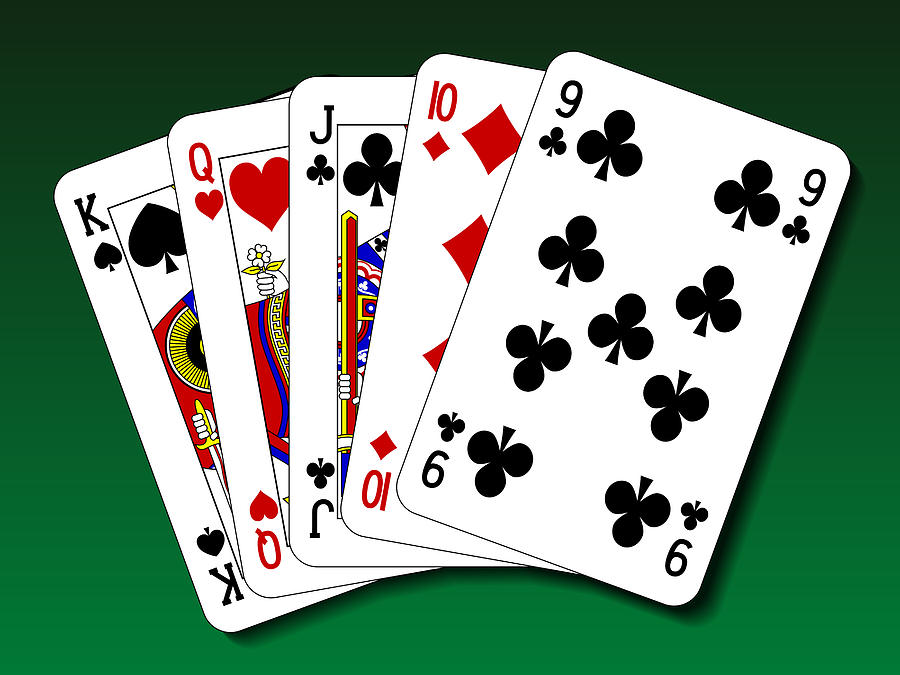
However, there’s a nuance—the strength of the hand varies depending on where your cards appear in the sequence. As with the single hole card case, the ideal spot is either at the high end or near the middle of the straight.
Straight Draws
A straight rarely comes together right on the flop. More often, players draw into it on the later streets—turn and river. But how can you tell if you’re close to a straight? By having three or four cards in sequence.
Backdoor Straight Draw. With three consecutive cards on the flop, it’s called a backdoor straight draw, which needs one specific card each on the turn and river. You have four outs on each street, but this type of draw is usually not worth chasing due to the low probability of completing the hand.
A straight draw is an incomplete straight missing just one card. However, it comes in two types with different odds: open-ended and gutshot.
Open-Ended Straight Draw. When the missing card is at either end of the sequence (e.g., 4-5-6-7), you need either a 3 or 8. With 8 outs (4 of each card), this draw is often played aggressively. By raising, you can either force opponents to fold or increase the pot if you complete the hand.
Gutshot Draw. A weaker option, needing one middle card to complete the straight (e.g., 3-4-6-7, which requires a 5). Gutshots include hands like A-2-3-4, or J-Q-K-A, needing a specific card to complete. With only 4 outs, gutshots have lower completion odds.

Straight Draw Probability: From the flop to the river, an open-ended straight completes about 32% of the time, while a gutshot only completes in about 17%.
A straight is a strong poker hand, but you should always consider how it’s formed to avoid losing to a higher straight. And knowing your straight draw odds helps you decide when to chase the hand profitably.