Straight draws are among the most common and strategically rich hands in poker. Whether you’re chasing the nuts on the flop or semi-bluffing with backdoor potential, understanding how to evaluate and play straight draws correctly can dramatically boost your win rate. But not all straight draws are created equal—and misjudging their value is one of the most frequent leaks in amateur play.
In this comprehensive guide, you’ll learn the difference between open-ended and gutshot straight draws, how to calculate their equity and odds, when to chase or fold, and how to use them as powerful semi-bluffing tools. We’ll also explore how straight draws function differently in Texas Hold’em versus Pot-Limit Omaha, including the high-powered wrap draws unique to the latter.
- What Is a Straight Draw in Poker?
- Open-Ended vs. Gutshot Straight Draws
- Open-Ended Straight Draw (OESD)
- Gutshot Straight Draw
- Calculating Odds and Equity for Straight Draws
- When to Play Straight Draws Aggressively
- Semi-Bluffing with Fold + Hand Equity
- When to Check or Call Instead
- Straight Draws in Omaha: Enter the Wrap
- Common Mistakes with Straight Draws
- Advanced Tips for Maximizing Value
- Conclusion: Play Smart, Not Hopeful
What Is a Straight Draw in Poker?
A straight draw is any hand that is one or two cards away from completing a five-card straight. Unlike made hands like top pair or sets, straight draws rely on future community cards to improve—but they often carry significant equity, especially when combined with other draws or overcards.
Straight draws fall into two main categories: open-ended straight draws (OESD) and gutshot (or inside) straight draws. While both aim for a straight, their probabilities, strategic value, and playability differ substantially.
Understanding these differences—and knowing how to read the board in poker to spot hidden straight possibilities—is essential for post-flop success.
Open-Ended vs. Gutshot Straight Draws
Open-Ended Straight Draw (OESD)
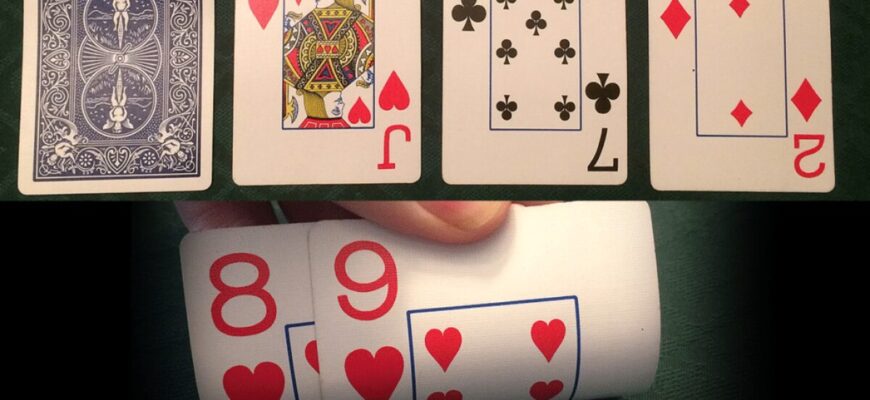
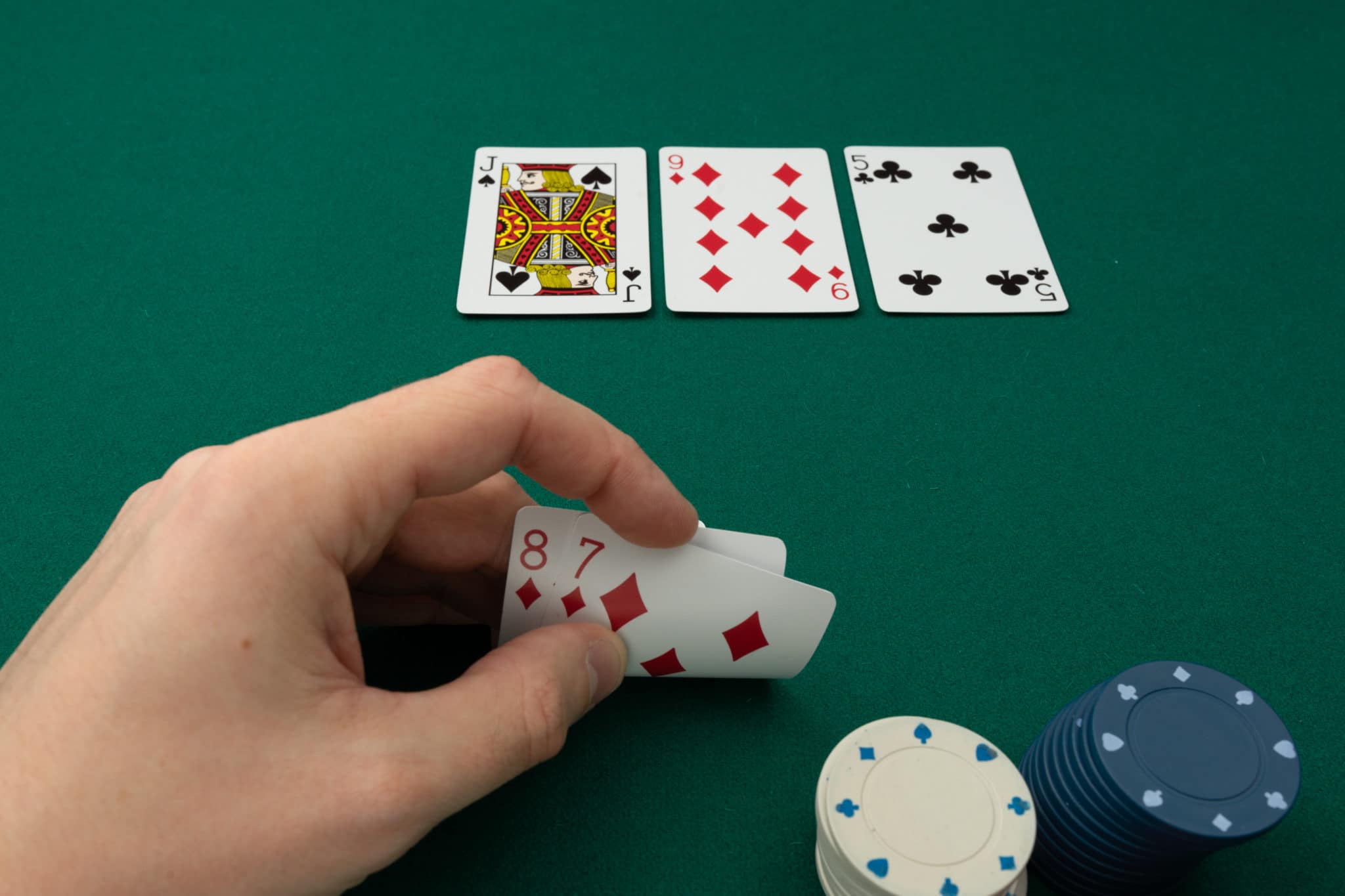
An open-ended straight draw occurs when you can complete your straight with either a high or low card. For example, holding 8♠7♣ on a 6♦5♥2♠ board gives you outs to any 4 or 9—eight total cards.
With 8 outs, an OESD has approximately:
- 32% equity to hit by the river
- 17% equity to hit on the turn alone
Because of its strong equity, an OESD is often worth calling or even betting, especially in position or when combined with overcards or backdoor flush potential.
Gutshot Straight Draw
A gutshot (or inside straight draw) requires one specific internal card to complete the straight. For example, holding 9♠8♣ on a T♦7♥2♠ board needs exactly a 6—just four outs.
This gives a gutshot only about:
- 16% equity by the river
- 8% equity on the turn
As detailed in our dedicated guide on what is a gutshot, these draws are rarely playable on their own. They become valuable only when paired with additional equity, such as overcards, a flush draw, or strong fold equity.
Calculating Odds and Equity for Straight Draws
To decide whether to continue with a straight draw, compare your hand’s equity to the pot odds you’re being offered. Use the Rule of 2 and 4 for quick mental math:
- One card to come (turn → river): Outs × 2 = approximate % chance
- Two cards to come (flop → river): Outs × 4 = approximate % chance
For an OESD (8 outs):
8 × 4 = ~32% on the flop
8 × 2 = ~16% on the turn
For a gutshot (4 outs):
4 × 4 = ~16% on the flop
4 × 2 = ~8% on the turn
Now compare that to the pot odds. If you must call $20 into a $60 pot, you’re getting 3:1 odds (25% equity needed). An OESD qualifies; a gutshot does not—unless implied odds or fold equity tip the scale.
For a full breakdown of outs and odds, see our guide on how to count outs in poker.
When to Play Straight Draws Aggressively
Semi-Bluffing with Fold + Hand Equity
Straight draws are ideal for semi-bluffing because they combine two paths to profit: your opponent folds (fold equity), or you hit your draw (hand equity). This is especially powerful on the flop and turn.
For example, holding J♠T♠ on a Q♣9♦3♥ board, you have an OESD plus backdoor flush potential. Betting here puts pressure on weaker top pairs and may win the pot immediately. If called, you still have strong equity to improve.
This dual threat is far more profitable than pure bluffs or passive draws. Always consider your position—semi-bluffing in position on the button is far more effective than out of position from the blinds.
When to Check or Call Instead
Not every straight draw should be bet. Consider checking or calling when:
- You’re out of position and unlikely to get folds
- The board is wet and your draw may be dominated (e.g., 8-7 on T-9-2 vs. J-x)
- You’re in a multi-way pot where aggression is less effective
- You have a gutshot with no additional equity
In these cases, calling (or even checking if checked to you) preserves chips while keeping you in the hand to realize your equity cheaply.
Straight Draws in Omaha: Enter the Wrap
In Pot-Limit Omaha, straight draws take on a whole new dimension thanks to four hole cards. Here, players often flop “wraps”—straight draws with 9 or more outs, sometimes exceeding 20 when combined with board connectivity.
A wrap is any straight draw with more than 8 outs, impossible in Hold’em. For example, with K♠Q♠J♦2♣ on a T♥9♣3♦ flop, you have 13 outs to the nut straight—all of which are clean and unbeatable.
Wraps are so central to Omaha strategy that they often dominate made hands like top pair. Learn more in our detailed article on what is a wrap in Omaha poker.
Key takeaway: In Omaha, evaluate straight draws not just by outs, but by how many are to the nuts. A 20-out wrap with only 6 nut outs is riskier than a 13-out nut wrap.
Common Mistakes with Straight Draws
- Chasing gutshots with poor odds: Calling large bets with just a gutshot is almost always a losing play unless implied odds are huge.
- Overvaluing non-nut straights: A 7-high straight on a 8-6-5 board can easily lose to 9-high or higher. Always ask: “Could I be drawing dead?”
- Bluffing into paired boards: On A♠A♦K♣, your K-Q may look like a straight draw—but your opponent could already have a full house.
- Ignoring reverse implied odds: Hitting your straight doesn’t guarantee profit if you lose a huge pot to a better straight or flush.
- Failing to combine draws: A straight draw with a flush draw (combo draw) has 15+ outs—treat it like a powerhouse, not a marginal hand.
Advanced Tips for Maximizing Value
- Use blockers to bluff credibly: Holding the 9 in a 8-7-6-5 board means your opponent can’t have the Broadway straight—making your bluff more believable.
- Delay aggression in multi-way pots: In 3+ player hands, checking an OESD can trap aggressive opponents or avoid bloating the pot out of position.
- Leverage turn cards: The turn often completes or kills straight draws. Use this knowledge to apply pressure or fold confidently—see our guide on how to play the turn and river.
- Factor in ICM in tournaments: Near the bubble of an MTT, calling with a straight draw may be -EV even with decent odds due to payout structure pressure.
Conclusion: Play Smart, Not Hopeful
Straight draws are powerful—but only when played with precision. Always calculate your equity, assess fold potential, and consider board texture before committing chips. In Hold’em, respect the difference between open-ended and gutshot draws; in Omaha, master the wrap to dominate the tables.
Start tracking your straight draw decisions this session: ask yourself “Do I have enough equity and fold potential to justify this bet or call?” Over time, this discipline will eliminate leaks and turn marginal spots into profitable opportunities.
Remember: poker isn’t about hoping to hit your draw—it’s about making mathematically sound decisions that win over the long run.