
EV, or Expected Value, is the anticipated profit or loss from any given action in poker. It represents mathematical expectations rather than actual outcomes, offering a way to evaluate your decisions and overall strategy.
In poker, EV reflects the profit you should gain from an action—but it doesn’t guarantee success. This is the difference between actual results and EV, which can vary due to poker variance—a mix of luck, randomness, and streaks of good or bad fortune.
Every decision—whether you fold, raise, or call—has a mathematical expectation, which is its EV. The profitability of your play hinges on whether that EV is positive or negative. For instance, someone might say, “That was a +EV move.” This means the action, like a call or raise, was mathematically advantageous, even if it didn’t pay off in that moment.
EV Formula and Practical Examples in Poker
Poker profits and losses hinge on your decisions, but the same decision can yield profits in one situation and losses in another. For example, going all-in with pocket aces heads-up will typically win 4 out of 5 times against random hands. EV represents the average likelihood of success over many such situations.
A Coin Toss Example
Let’s simplify with a coin toss game. Imagine a game where heads earns you $1, and tails costs you $1. According to probability theory, heads and tails will appear equally over an infinite number of flips. For 100 flips, 50 will be heads, and 50 will be tails. Here’s how you calculate EV:
EV = (1×50 + (-1)×50) / 100 = 0
This means the expected value of this game is zero—neither profitable nor unprofitable. Similarly, in poker, some plays have neutral or near-neutral EV outcomes.
Now, let’s change the game. Suppose heads earns you $2, but tails still costs you $1. Here’s the new calculation:
EV = (2×50 + (-1)×50) / 100 = 0.5
This setup yields a $0.50 profit per toss on average. While some tosses will lose, the long-term expectation remains positive.
Conversely, if heads wins $1 but tails loses $2, the calculation changes:
EV = (1×50 + (-2)×50) / 100 = -0.5
This setup results in an average loss of $0.50 per toss, making the game unprofitable over time.
How to Use EV in Poker
In poker, you can analyze every action through the lens of EV to determine if it’s profitable over the long term.
A Flush Draw Example
Let’s say you’re on the turn with a flush draw. The pot contains $60, and your opponent bets $10. Should you call or fold? A flush draw completes 20% of the time (1 in 5). This means:
- In 20% of cases, you’ll win $70 ($60 pot + $10 call).
- In 80% of cases, you’ll lose $10 (the cost of your call).
The EV calculation looks like this:
EV = (70×0.2) + (-10×0.8) = $6
Calling here has a positive EV of $6 over the long term. If you fold, you’d miss out on this expected profit.
Keep in mind that variance can still lead to streaks of losses. For instance, you might miss your flush 20 times in a row. However, that doesn’t make calling incorrect. EV ensures your decisions are mathematically sound regardless of short-term results.
Beyond the Basics: Factors That Affect EV in Poker
The flush draw example focuses on pot odds and probabilities, but real poker scenarios involve more complexities. Here are some factors that also influence EV:
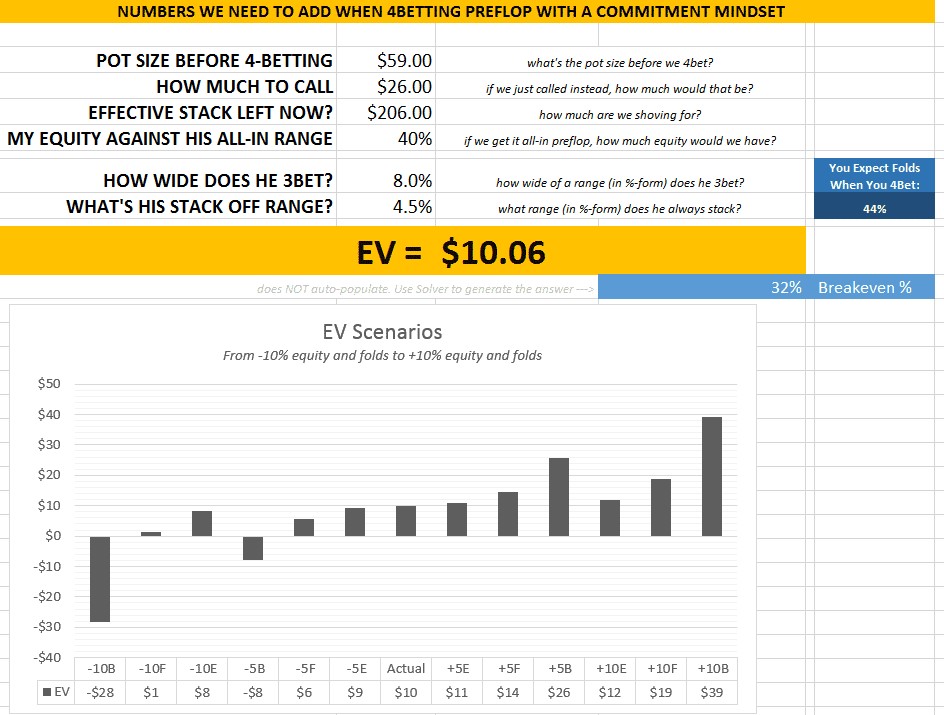
- Fold Equity: Sometimes, a re-raise can force your opponent to fold, increasing your EV by avoiding the need to see the river.
- Opponent Tendencies: Adjusting your play to exploit an opponent’s weaknesses can improve your EV.
- Board Dynamics: Understanding the potential outcomes of the community cards can refine your decision-making.
Accounting for these factors helps you make more accurate EV calculations and smarter in-game choices.
Why EV is Crucial for Poker Players
EV is one of the most important metrics in poker. It allows players to evaluate the profitability of their actions without being swayed by short-term variance. By understanding and applying EV, you can:
- Analyze your sessions and pinpoint mistakes.
- Focus on actions that are mathematically justified.
- Build a long-term winning strategy.
Remember, EV doesn’t promise immediate wins—it’s a tool for the bigger picture. With consistent application, you’ll improve your game and maximize your profits over time.


