

Poker solvers like PioSOLVER, MonkerSolver, and GTO+ have revolutionized how players learn the game. But simply running a simulation and memorizing outputs won’t make you better. Most players misuse solvers—chasing perfection instead of understanding patterns, or applying GTO blindly against fish who fold top pair every river. The real power of solvers lies not in copying their actions, but in extracting strategic intuition you can use against real opponents.
In this guide, we’ll show you how to study solvers effectively: what to focus on, what to ignore, and how to bridge the gap between theoretical perfection and practical exploitation. Whether you’re a tournament grinder or cash game regular, this method will help you turn solver data into consistent profit—without burning out on endless trees.
- Why Most Players Fail with Solvers
- Start Small: Focus on Single Spots
- Look for Patterns, Not Exact Frequencies
- Compare vs. Your Own Play
- Use Solver Outputs to Improve Hand Reading
- Adjust for Real Opponents: GTO as a Base, Not a Cage
- Avoid These Common Solver Traps
- Build a Personal Database of Key Spots
- Solvers in Tournaments: Account for ICM
- When to Stop Studying and Start Playing
- Final Word: Solvers Are Teachers, Not Masters
Why Most Players Fail with Solvers
The biggest mistake is treating solvers as answer keys. A solver shows the optimal strategy for a specific set of assumptions—stack sizes, bet sizes, ranges—but real games rarely match those conditions exactly. Copying its bluff frequency on a random board without understanding why it bluffs leads to robotic, unprofitable play.
Worse, many players run full trees for common spots (e.g., button vs. big blind SRP) but never review the results. They collect data without insight—like reading a book while blindfolded.
Running 100 solver simulations and never revisiting them is worse than not using a solver at all—it creates false confidence without real learning.
Start Small: Focus on Single Spots
Don’t try to solve your entire preflop strategy at once. Pick one specific situation and go deep:
- Button opens, big blind calls, flop is K♠ 7♦ 2♣
- UTG raises, you 3-bet from BB with A♠ 5♠, flop is Q♥ J♣ 3♦
- Turn is 4♠ on a 9♣ 6♦ 2♥ 4♠ board after double barrel
Ask: What is my range doing here? How often am I betting? What hands am I betting with? Why?
Limit your first session to one flop texture. Study it until you can predict the solver’s action before looking. That’s when intuition begins.
Look for Patterns, Not Exact Frequencies
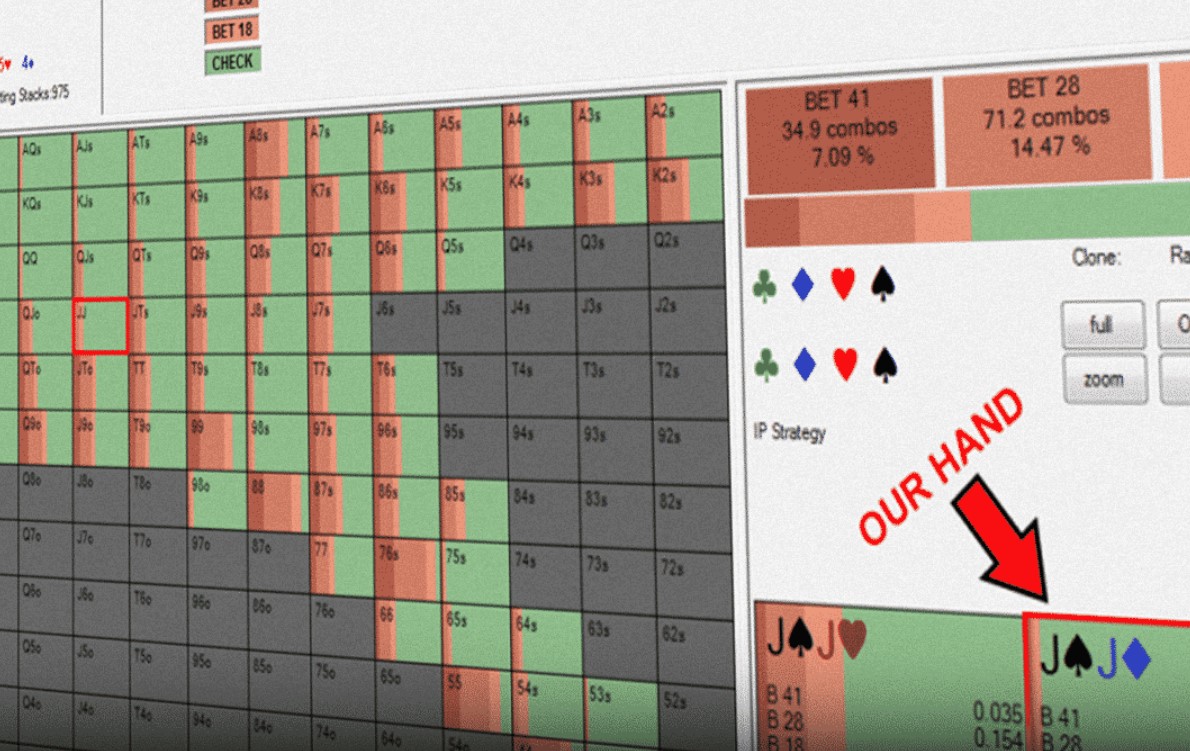
You won’t remember that the solver bets 63.7% of the time on K72 rainbow. But you will remember: “On dry, unpaired boards, the in-position player bets medium-high frequency with a merged value range and few bluffs.”
Focus on these high-level takeaways:
- Is the range polarized or merged?
- Are bluffs using blockers (e.g., A-high hands on ace-high boards)?
- Does the solver check back strong hands for balance?
Solvers bluff more with nut blockers (A♠ on spade boards) and less with weak kickers. This pattern matters more than the exact 28.4% bluff frequency.
Compare vs. Your Own Play
Before looking at the solver, simulate the spot yourself:
- What would you do with A♠ K♦ on Q♦ J♣ 5♠?
- What about 8♠ 7♠?
- Would you bluff with T♦ 9♦?
Only then check the solver. The gap between your instinct and the solution is your learning zone. If you always bluff with T9o and the solver never does, ask why. Maybe your hand has no equity when called.
If you skip this step, you’re just passively consuming data—not actively rewiring your decision-making.
Use Solver Outputs to Improve Hand Reading
Solvers don’t just tell you what to do—they reveal how ranges interact. On a board like T♠ 8♠ 3♦, the solver might show that X% of the button’s betting range is flush draws, Y% is top pair, Z% is bluffs.
Use this to refine your hand reading skills. When an opponent bets, ask: “If they played GTO, what part of their range is this?” Even if they don’t, the baseline helps you spot deviations.
Great players don’t guess opponents’ hands—they eliminate parts of a GTO-based range and adjust from there.
Adjust for Real Opponents: GTO as a Base, Not a Cage
Solver strategy assumes your opponent also plays perfectly. But real players don’t. Use solver ranges as a foundation, then exploit:
- If your opponent folds too much to turn barrels, bluff more than the solver suggests.
- If they never fold top pair on the river, remove bluffs and value bet thinner.
- If they over-defend the big blind, widen your opening range.
Should you ever ignore the solver completely? Yes—against extreme fish who call every street, pure exploitative play (bet every value hand, never bluff) beats GTO.
For more on balancing theory and exploitation, see exploitative play vs. GTO.
Avoid These Common Solver Traps
- Overfitting to one bet size: Solvers often use multiple sizes. Don’t assume 66% pot is always correct.
- Ignoring rake: Solver trees usually assume no rake. In high-rake games, bluffing less is often better.
- Using wrong ranges: If your preflop ranges don’t match reality, the post-flop output is meaningless.
- Studying river before flop: Master early streets first—later decisions depend on earlier ones.
Running a solver with incorrect opponent ranges (e.g., assuming they call 3-bets with 72o) produces garbage. Garbage in, garbage out.
Build a Personal Database of Key Spots
Create a simple note system:
- Flop type: dry, wet, paired, monotone
- Your position and role (IP/OOP, aggressor/caller)
- Solver’s main strategy: merged bet, polarized check-raise, etc.
- Your key takeaway
Example:
“Dry K72r, IP vs OOP caller → 60% bet, merged value (top pair+), few bluffs. Bluffs have backdoor equity.”
Review this database for 10 minutes before each session. It’s more effective than running new simulations.
Solvers in Tournaments: Account for ICM
Standard solvers assume cash game rules. In tournaments, ICM changes everything. Near the bubble, you should bluff less and call tighter—even if the solver says otherwise.
Specialized tools like ICMIZER or PioSOLVER with ICM plugins help, but for most players, it’s enough to know: “In high-ICM spots, deviate from GTO toward conservative play.”
A solver might shove 20% of hands on the bubble, but ICM says 8%. Never trust standard solver output in late-stage MTTs without adjustment.
When to Stop Studying and Start Playing
You don’t need to solve every spot. Once you recognize patterns—like “solver always checks back sets on paired boards to balance”—you’ve learned enough to move on. The goal isn’t perfection; it’s better decisions.
If you can explain why the solver does something in plain English, you’re ready. If you’re still memorizing percentages, you’re not.
“Solvers don’t play poker. You do. Use them to sharpen your mind, not replace it.”
Final Word: Solvers Are Teachers, Not Masters
Used correctly, solvers accelerate your growth by showing you what’s possible. But they don’t beat your opponents—you do. Focus on understanding the logic behind each action, not the action itself. Over time, you’ll internalize GTO principles and blend them with exploitative adjustments—becoming unexploitable against regs and lethal against fish.
Stop chasing the “correct answer.” Start asking “why.” That’s where real mastery begins.
Your next step: pick one flop you played yesterday. Re-solve it. Compare your action to the solver’s. Write down one strategic insight. Repeat weekly. This habit alone will transform your game.


