
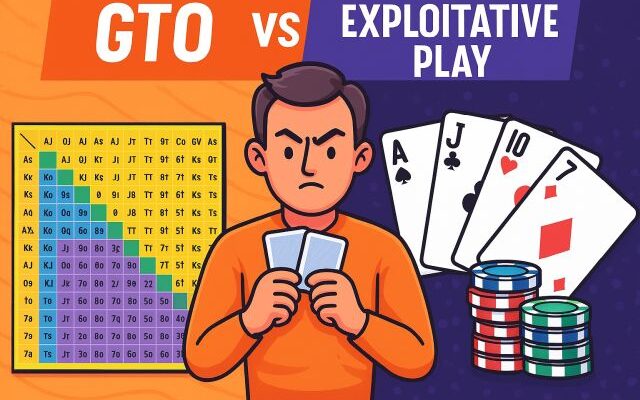
Game Theory Optimal (GTO) strategy gives you a mathematically unexploitable baseline—but it won’t maximize your profit against real opponents. Exploitative play targets specific player tendencies, but it risks being countered if misapplied. The winning formula isn’t choosing one over the other—it’s knowing when to switch between them based on your opponents, game type, and table dynamics.
In this guide, we’ll break down the core differences between GTO and exploitative strategies, show real-world examples of each, and—most importantly—explain exactly when to abandon balanced play in favor of targeted aggression. Whether you play cash games, MTTs, or Omaha, mastering this switch is the hallmark of elite poker players.
- What Is GTO Poker Strategy?
- What Is Exploitative Play?
- When to Use GTO: The Foundation
- When to Switch to Exploitative Play
- Real-World Example: Button vs. Big Blind
- Exploitation in Tournaments: Bubble and ICM
- Dangers of Over-Exploitation
- Hybrid Approach: GTO as a Base, Exploitation on Top
- Post-Flop Exploitation: Turn and River
- Common Mistakes in Strategy Switching
- Advanced Tip: Exploiting Anti-Exploitation
- Final Word: Strategy Is Fluid, Not Fixed
What Is GTO Poker Strategy?
GTO (Game Theory Optimal) is a strategy that makes your play unexploitable by balancing your ranges perfectly. This means your bluffs, value bets, and calls occur in proportions that prevent opponents from profiting—no matter how they adjust. GTO doesn’t try to “read” opponents; it assumes they play perfectly and defends accordingly.
For example, in a GTO river spot where you’re checking back 70% of your range, you’ll include both strong hands and bluffs in the remaining 30% that you bet. An opponent can’t tell whether you’re bluffing or value betting, making every decision against you breakeven in the long run.
GTO is a defensive shield, not an offensive weapon. It protects you from being exploited—but it also leaves money on the table against imperfect players.
For a full breakdown of the framework, see GTO poker strategy.
What Is Exploitative Play?
Exploitative play adjusts your strategy to capitalize on opponent weaknesses. If a player folds too much to aggression, you bluff more. If they call too wide, you value bet thinner and bluff less. Unlike GTO, exploitative play is dynamic and opponent-specific.
Example: A recreational player on the river folds to any bet over half pot. A GTO strategy might bluff 25% of the time in this spot. An exploitative player bluffs 60%—knowing the opponent will fold even strong hands like second pair.
Exploitative play generates the highest profit against weak or predictable opponents. It’s the reason why top grinders crush microstakes—they’re not playing balanced—they’re attacking leaks.
When to Use GTO: The Foundation
GTO should be your default strategy when:
- You face unknown or strong opponents
- You’re multi-tabling and can’t track tendencies
- You play in high-stakes games where opponents adjust quickly
- You’re new to a format (e.g., Short Deck or PLO) and lack reads
In these situations, GTO keeps you safe from self-inflicted leaks. It’s especially useful on early streets (flop and turn), where ranges are wide and reads are scarce.
Don’t confuse “playing GTO” with “playing rigidly.” Even GTO solvers adjust to bet sizing, stack depth, and board texture—just not to opponent tendencies.
When to Switch to Exploitative Play
Switch to exploitative play the moment you identify a consistent leak. Common triggers include:
- Opponent folds to river bets >60% of the time
- Opponent calls 3-bets with any two cards
- Opponent never bluffs on paired boards
- Opponent over-defends the big blind vs. button opens
For instance, if a player calls every continuation bet on the flop but folds to double barrels, you should fire second barrels with almost any hand—even complete air. This is pure exploitation.
Use HUD stats or mental notes to confirm tendencies over multiple hands. One fold doesn’t mean a player is tight—five folds in a row does.
Sharpen your reads with how to read your opponents in poker.
Real-World Example: Button vs. Big Blind
Scenario: You’re on the button with K♠ 7♦. The big blind is a known calling station who defends 70% of big blinds and folds rarely post-flop.
GTO approach: Fold preflop—K7o is outside the optimal opening range vs. a standard defender.
Exploitative approach: Open-raise. You’ll get called wide, and your top pair or overcards will often hold up. Even when you miss, your opponent checks most flops, letting you steal with a c-bet.
Using exploitative opens against a good regular who 3-bets light will get you destroyed. Always verify your read first.
Exploitation in Tournaments: Bubble and ICM
Tournaments add another layer: ICM (Independent Chip Model). Near the bubble, many players tighten drastically. This creates a golden exploitative opportunity: shove wider from late position, knowing tight opponents will fold even decent hands.
GTO ignores payout structures—it only cares about chip EV. But exploitative play embraces ICM, targeting survival-driven folds to accumulate chips risk-free.
On the bubble with a medium stack, exploit tight short stacks by opening 80% of hands from the button. They can’t call without risking elimination.
Dangers of Over-Exploitation
Exploitative play has risks. If you bluff too much against a player who suddenly starts calling down, you’ll lose big pots. Similarly, value betting too thin against a tricky opponent may get you check-raised off your best hand.
Worst of all, many players mistake randomness for tendency. Folding once doesn’t mean an opponent is weak—it might be a trap.
Bluffing every river against a “passive” player who actually slow-plays monsters is a fast way to go broke. Confirm patterns before deviating from GTO.
Hybrid Approach: GTO as a Base, Exploitation on Top
The smartest players use GTO as a scaffold, then layer on targeted adjustments. For example:
- Open the GTO button range (e.g., 50% of hands)
- If the big blind folds 60%+ to 3-bets, 3-bet more bluffs than GTO suggests
- If they never fold top pair, remove river bluffs from your range
This hybrid model minimizes your own leaks while maximizing profit from theirs.
Start every session playing close to GTO. As you gather data, make one or two small exploitative adjustments per opponent—not full strategy overhauls.
Post-Flop Exploitation: Turn and River
Late streets offer the richest data for exploitation. If an opponent always checks the turn with weak hands, you can bet for value with second pair. If they barrel every scary card, you can float with draws and take the pot away on the river.
For example, holding 9♠ 8♠ on a T♠ 7♦ 2♣ flop, you call a c-bet. The turn is Q♥. If your opponent checks, they likely missed. A bet here wins more than checking back.
Should you always bluff when you think they’re weak? No. Consider pot size, stack depth, and their bluff-catching history. A huge river bet into a nit is rarely called—but a small one might be.
Master these decisions with turn and river in poker: how to play the toughest streets.
Common Mistakes in Strategy Switching
- Playing GTO against obvious fish—you’re leaving money on the table
- Going full LAG against regulars—they’ll counter-exploit you
- Adjusting too quickly—one hand isn’t a sample
- Ignoring position—exploitation is strongest in position where you control the action
Assuming all recreational players are “passive” is dangerous. Some are maniacs who call every street—exploit them by value betting huge and never bluffing.
Advanced Tip: Exploiting Anti-Exploitation
Strong players sometimes fake weaknesses to lure you into over-exploiting. They’ll fold a few rivers to set up a big call later. To counter this:
- Track their showdowns—do they actually fold the hands you think they do?
- Use balanced lines—bluff sometimes, but not every time
- Stay within GTO frequencies unless you have high-confidence data
The best exploiters know when to revert to GTO. It’s not about always attacking—it’s about attacking at the right time, in the right way.
Final Word: Strategy Is Fluid, Not Fixed
There’s no universal “best” strategy in poker. GTO keeps you safe; exploitation makes you rich. The key is situational awareness: against unknowns, play GTO. Against fish, attack leaks. Against thinking players, mix both.
Never let ego dictate your style. If your exploitative bluff gets called, don’t tilt—reassess. Maybe they’re not weak. Maybe it’s time to go back to balanced play—until the next leak appears.
“GTO is the map. Exploitation is the compass. You need both to navigate poker’s chaos.”
Your next session: pick one opponent and note one clear tendency (e.g., “folds to 3-bets”). Deviate from GTO in that exact spot once. Observe. Adjust. Repeat. This disciplined approach beats blind aggression every time.


