

Game Theory Optimal (GTO) poker strategy is a mathematically sound approach that makes your play unexploitable—meaning opponents can’t consistently profit from your decisions, no matter how they adjust. Originally developed from game theory principles, GTO has become essential for serious players in both cash games and multi-table tournaments (MTTs).
While GTO doesn’t guarantee you’ll win every hand, it provides a balanced foundation that minimizes losses and maximizes long-term expected value (EV). In this guide, we’ll unpack how GTO works, when to use it over exploitative play, and how to integrate it into your game without overcomplicating things.
- What Is GTO in Poker?
- GTO vs. Exploitative Play: Which Is Better?
- Core GTO Concepts Every Player Should Know
- 1. Balanced Ranges
- 2. Minimum Defense Frequency (MDF)
- 3. Polarized vs. Linear Betting
- Applying GTO in Real Poker Situations
- Pre-Flop GTO Strategy
- Post-Flop GTO Play
- GTO in Tournaments vs. Cash Games
- Common GTO Misconceptions and Mistakes
- How to Start Learning GTO Poker
- When GTO Isn’t Enough: The Role of Reads
- Final Thoughts: GTO as Your Poker Compass
What Is GTO in Poker?
GTO stands for “Game Theory Optimal.” In poker, it refers to a strategy that is perfectly balanced: your bluffs, value bets, checks, and calls are mixed in such a way that no opponent can exploit you by adjusting their play. If both players play perfect GTO, the result is a Nash equilibrium—neither gains an edge over the other.
This doesn’t mean GTO is passive or weak. On the contrary, it often involves aggressive actions like frequent check-raises or polarized betting ranges. The key is balance: for every bluff, there’s a corresponding value hand that justifies it.
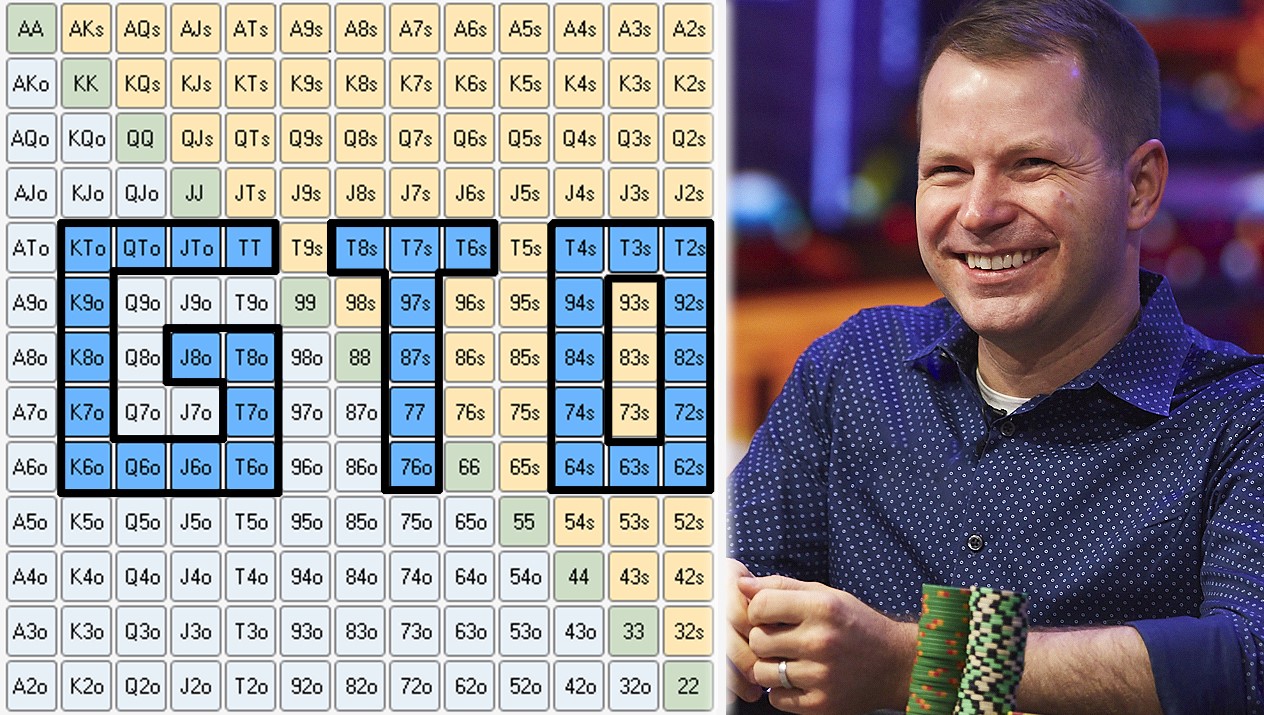
GTO is most commonly applied in heads-up and 6-max No-Limit Texas Hold’em, where solvers like PioSolver or GTO+ have mapped out optimal strategies for thousands of spots. However, the principles also extend to Omaha and other variants when adapted correctly.
GTO vs. Exploitative Play: Which Is Better?
Many beginners assume GTO is always superior—but that’s a myth. In reality, the best players blend GTO with exploitative adjustments based on opponent tendencies.
- GTO Play: Ideal against strong, unknown, or highly adaptive opponents. It protects you from being outplayed.
- Exploitative Play: Better against weak or predictable players. For example, if an opponent never bluffs the river, you should fold more often than GTO suggests.
Think of GTO as your defensive baseline. When you’re unsure how an opponent plays—or when you’re multi-tabling and can’t track tendencies—falling back on GTO prevents costly leaks. But when you spot clear weaknesses (e.g., someone folds too much to 3-bets), deviating from GTO to exploit them is the higher-EV choice.
Core GTO Concepts Every Player Should Know
1. Balanced Ranges
GTO requires you to construct ranges that include both strong hands and bluffs in the right proportions. For instance, on a dry flop like K♠7♦2♣, your betting range from the button might include top pair, sets, and some bluffs like A-high with backdoor draws.
If you only bet your strong hands, observant opponents will fold every time—costing you value. If you bluff too much, they’ll start calling with marginal hands. GTO finds the sweet spot where your range is indifferent to their response.
2. Minimum Defense Frequency (MDF)
MDF tells you how often you must call a bet to prevent your opponent from profiting with any two cards. For example, if your opponent bets half the pot, you need to defend at least 67% of the time to make their bluffs break even.
This doesn’t mean you should call 67% of hands blindly. Instead, you select the best hands from your range to defend—those with showdown value or strong drawing potential. Understanding MDF helps you avoid overfolding, a common leak among recreational players.
3. Polarized vs. Linear Betting
GTO often uses polarized ranges (very strong hands + bluffs) on certain streets, especially the river. On earlier streets like the flop, linear ranges (medium-strength to strong hands) are more common.
For example, on a coordinated board like 9♠8♠7♦, GTO might favor a linear continuation bet with hands like T9, 88, or QJ. But on a blank river like K♠8♦7♣2♥3♣, the betting range becomes polarized: either you have a king or you’re bluffing with air.
Applying GTO in Real Poker Situations
Pre-Flop GTO Strategy
Pre-flop is the most solved part of poker. GTO charts dictate which hands to open, 3-bet, or fold from each position. For example, from early position in a 100BB cash game, GTO suggests opening only the top 10–15% of hands—think pairs, broadways, and suited connectors.
From the button, the range widens dramatically (up to 50%+), including hands like J5s or T8o. These “wide opens” are backed by post-flop equity and position. If you’re unsure what to play pre-flop, start with a solid GTO-based opening chart and adjust as you learn opponent tendencies. See our guide on which hands to play preflop for practical starting ranges.
Post-Flop GTO Play
Post-flop is where GTO gets complex—but also powerful. On the flop, GTO emphasizes board texture, range advantage, and nut potential. For example, if you raised pre-flop and the flop comes A♠Q♦2♣, you likely have a range advantage because you hold more AQ, AA, and QQ combinations than your opponent.
In such spots, GTO recommends betting frequently—both for value and as a bluff with hands like KJ or suited gutshots. Conversely, on a board like 7♠6♠5♦ where your opponent could have hit hard, GTO often checks more often to control pot size.
On the turn and river, GTO becomes highly polarized. Bluffing frequencies depend on bet size: smaller bets require fewer bluffs; overbets demand more. Always consider whether your bluff blocks your opponent’s calling range—a hand like A♠K♠ blocks strong aces and is a poor bluff on an A-high board.
GTO in Tournaments vs. Cash Games
GTO principles apply to both formats, but tournament dynamics add layers like blinds, antes, and ICM (Independent Chip Model) that shift optimal play.
In early tournament levels with deep stacks (100+ BBs), GTO closely mirrors cash game strategy. But as stacks shorten (under 20 BBs), GTO shifts toward push/fold charts—where every decision is either an all-in or a fold. Near the bubble, ICM pressure may make calling a +EV all-in incorrect if elimination risks a much larger payout drop.
In cash games, GTO is more stable because stack sizes and payout structures don’t change. This makes cash games the ideal training ground for learning GTO before applying it in high-variance tournaments.
Common GTO Misconceptions and Mistakes
- “GTO means never bluffing.” False—GTO includes bluffs in precise frequencies to balance value bets.
- “I must follow GTO exactly.” Over-reliance on GTO against weak players costs money. Use it as a baseline, not a straitjacket.
- “GTO ignores opponent reads.” While pure GTO assumes no reads, real-world GTO-informed play integrates reads to decide when to deviate.
- “GTO works the same in all games.” GTO for Pot-Limit Omaha differs significantly from Hold’em due to hand equities and wrap draws.
Another frequent error is misapplying GTO bet sizing. Many solvers recommend multiple bet sizes per street (e.g., 33%, 66%, 150% of pot), but beginners often default to one size. This makes their range predictable and easier to exploit.
How to Start Learning GTO Poker
You don’t need a PhD in math to benefit from GTO. Here’s a practical roadmap:
- Study pre-flop charts: Use free or paid GTO tools to memorize opening, 3-betting, and defending ranges by position.
- Practice with solvers: Input common flop spots into free simulators to see how GTO mixes value and bluffs.
- Review your hands: Compare your decisions to GTO recommendations using tracking software like Hold’em Manager.
- Focus on key concepts: Master MDF, range advantage, and polarization before diving into advanced solver outputs.
For beginners, freerolls and micro-stakes cash games are great places to experiment. As noted in our guide on building a bankroll with freerolls, playing solid, unexploitable poker—even without perfect reads—can yield consistent results over volume.
When GTO Isn’t Enough: The Role of Reads
GTO shines when you lack information—but poker is a people game. Against opponents who show clear patterns (e.g., never bluffing rivers or overfolding to 3-bets), pure GTO leaves money on the table.
For example, if a player folds 80% to continuation bets, GTO might suggest bluffing 30% of the time—but an exploitative approach would bluff 60%+. Conversely, if someone calls every river bet, you should bet only for value and skip the bluffs entirely.
The goal isn’t to choose between GTO and exploitation—it’s to use GTO as your foundation and layer in reads when they’re reliable. This hybrid approach is what separates elite players from the rest.
Final Thoughts: GTO as Your Poker Compass
GTO poker strategy isn’t about robotic play—it’s about understanding the mathematical backbone of the game so you can make smarter decisions under pressure. Whether you’re grinding MTTs, playing cash, or just trying to win at poker more consistently, GTO gives you a reliable framework that works against any opponent.
Start small: learn pre-flop ranges, understand why you bet or check, and use GTO as a reference—not a rulebook. Over time, these concepts will become second nature, and you’ll instinctively balance your bluffs, protect your value, and avoid being exploited. That’s the real power of GTO.


