
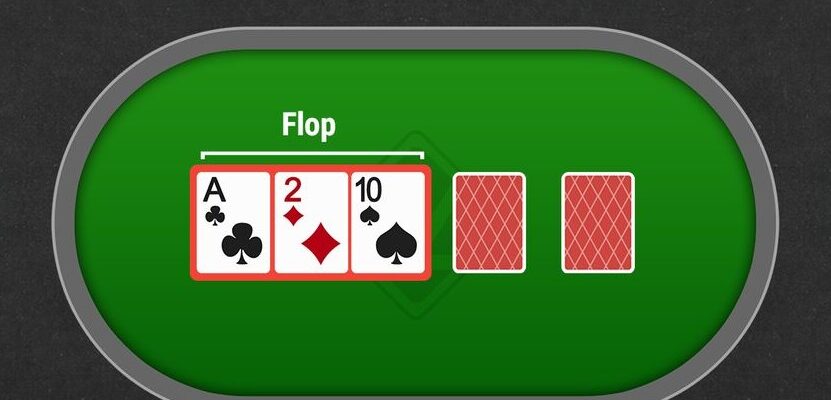
The flop is where poker transitions from theory to action. After the preflop betting round, the dealer reveals the first three community cards—suddenly turning potential into reality. Whether you’ve hit a monster, a draw, or completely whiffed, your decisions on the flop shape the entire trajectory of the hand.
In this expert-level guide, you’ll learn how to evaluate flops accurately, choose the right line (bet, check, raise, or fold), and avoid the most common post-flop leaks. From equity considerations to board texture awareness, we’ll break down everything you need to turn the flop into your strategic advantage—whether you’re playing cash games, tournaments, or Pot-Limit Omaha.
- What Happens on the Flop?
- Classifying Flop Textures
- 1. Dry vs. Wet Flops
- 2. Paired and Monotone Flops
- Key Strategic Decisions on the Flop
- 1. Should You C-Bet?
- 2. When to Check Back
- 3. Check-Raising for Value or Bluff
- Flop Equity and Hand Categorization
- Omaha vs. Hold’em: Flop Dynamics
- Common Flop Mistakes to Avoid
- Advanced Flop Tips for Winning Players
- Conclusion: Turn the Flop Into Your Edge
What Happens on the Flop?
The flop consists of the first three community cards dealt face-up in Texas Hold’em and Omaha. It’s the first post-flop betting round and the point where players finally see 5 out of 7 total cards (including their hole cards). This reveals approximately 71% of the final board—enough to assess hand strength, potential draws, and opponent ranges with far greater precision.

For the preflop aggressor, the flop is often a chance to continue their initiative with a continuation bet (c-bet). For the caller, it’s an opportunity to fight back with check-raises, float calls, or timely folds. Every action must account for position, stack depth, and the texture of the board itself.
Understanding how to read the board in poker is essential. A dry, unconnected flop like K♠7♦2♣ plays very differently than a coordinated, draw-heavy board like J♥T♥9♣.
Classifying Flop Textures
1. Dry vs. Wet Flops
Dry flops have little to no straight or flush potential—think A♣8♦2♠. These boards favor the preflop aggressor, as callers are less likely to have connected meaningfully. C-betting here is highly profitable, especially in heads-up pots.
Wet flops are coordinated and draw-heavy—like Q♠J♠T♦ or 8♥7♥6♣. These boards hit a wide range of hands and give many players strong draws. C-betting too frequently here can be exploited, as opponents will float or raise with equity-rich holdings.
2. Paired and Monotone Flops
A paired flop (e.g., 9♠9♦4♣) reduces the number of possible two-pair and full house combinations but increases the value of trips. Be cautious when your top pair faces aggression on these boards—your opponent may have a full house or be representing one.
A monotone flop (all cards of the same suit, like K♥9♥4♥) creates immediate flush concerns. Even if you hold the A♥, your opponent could have a lower flush. These boards often warrant smaller bets or even checks with marginal holdings.
Key Strategic Decisions on the Flop
1. Should You C-Bet?
Continuation betting is one of the most powerful post-flop tools—but it must be used selectively. As a general rule:
- Bet dry, unconnected boards with high frequency (70–90%)
- Bet less on wet, coordinated boards (30–50%)
- Always consider your position: c-betting in position is more profitable than out of position
For a deeper dive into post-flop play, see our guide on how to play post-flop. Remember: a c-bet isn’t always for value—it can also be a semi-bluff with backdoor equity or a pure bluff to take down dead money.
2. When to Check Back
Checking back (or checking in general) is often the right move when:
- You have a medium-strength hand that doesn’t want to build a big pot (e.g., second pair)
- You’re out of position and lack a clear plan
- The board heavily favors your opponent’s range (e.g., you called a preflop 3-bet and the flop comes A-K-Q)
Don’t view checking as passive—it’s a strategic choice that preserves chips and keeps you in the hand to reevaluate on the turn.
3. Check-Raising for Value or Bluff
The check-raise is a high-impact weapon on the flop. Use it with:
- Strong value hands: sets, two pair, or the nut straight
- Semi-bluffs: combo draws like a flush draw + gutshot
- Bluffs: on boards where your opponent c-bets too wide (e.g., dry boards against a TAG player)
Be cautious in multi-way pots—check-raising can backfire if another player cold-calls behind you.
Flop Equity and Hand Categorization
Once the flop hits, classify your hand into one of four categories:
- Monster hands** (nuts or near-nuts): Bet for value. Think sets, straights, or flushes on non-threatening boards.
- Strong but vulnerable hands: Top pair with a good kicker or overpairs on dry boards. Bet for protection and value.
- Draws: Flush draws, open-ended straight draws (learn more), or gutshots (what is a gutshot?). Consider semi-bluffing if you have fold equity.
- Air: Missed completely. Decide whether to bluff (if the board allows) or fold in poker gracefully.
Your decision should reflect both your hand’s equity and your opponent’s likely folding frequency. Combine this with equity in poker calculations to make mathematically sound choices.
Omaha vs. Hold’em: Flop Dynamics
In Pot-Limit Omaha, the flop is even more critical due to the increased likelihood of strong hands and draws. With four hole cards, players frequently flop:
- Wrap straight draws (9+ outs)—see our guide on what is a wrap in Omaha
- Combo draws (flush + straight potential)
- Sets or two pair
Because so many hands connect strongly, bluffing is less effective in PLO. Instead, focus on betting for value with the nuts or nut-equivalent draws. Over-betting marginal hands is a common mistake—Omaha pots get big fast, and reverse implied odds are severe.
Common Flop Mistakes to Avoid
- C-betting every flop: Against observant opponents, this becomes predictable and exploitable. Mix in check-backs with strong hands to balance your range.
- Overvaluing top pair: On wet or paired boards, top pair with a weak kicker is often a bluff-catcher—not a value hand.
- Ignoring position: Out of position, you should c-bet less and check more. In position, you can apply constant pressure.
- Bluffing the wrong boards: Don’t bluff into monotone or connected boards unless you have blockers or backdoor equity.
- Failing to adjust to opponent type: Against calling stations, skip bluffs and focus on value. Against nits, increase bluff frequency on dry boards.
Advanced Flop Tips for Winning Players
- Use blockers to bluff credibly: Holding the A♠ on a flush board makes it less likely your opponent has the nut flush—making your bluff more believable.
- Delay c-bets in multi-way pots: In 3+ player pots, checking back with marginal hands avoids bloating the pot out of position.
- Track your flop cbet stats: Aim for a 60–70% c-bet frequency in heads-up pots, but significantly lower in multi-way scenarios.
- Think in ranges, not hands: Ask: “What part of my range should bet here?” not “Should I bet with this exact hand?”
- Prepare for the turn: Every flop decision should consider how you’ll react to future cards. A plan that ends at the flop is incomplete.
Conclusion: Turn the Flop Into Your Edge
The flop is where poker strategy truly comes alive. By mastering board texture analysis, hand categorization, and strategic betting frequencies, you’ll extract maximum value with strong hands, protect your equity with draws, and fold without regret when you miss.
Start applying these concepts today: in your next session, consciously categorize every hand after the flop and ask yourself—“Am I in the monster, strong, draw, or air bucket?” Then choose your action based on equity, position, and opponent tendencies. Over time, this disciplined approach will transform your post-flop game and put you ahead of 90% of your opponents.
Remember: winning isn’t just about the cards you’re dealt—it’s about how you play them after the flop.


