The ace is poker’s ultimate shape-shifter—capable of forming both the strongest and weakest straights in the game. The ace-high straight (A-K-Q-J-10), known as “Broadway,” is the highest possible straight. But on the flip side, the same ace can serve as a low card in A-2-3-4-5—the “wheel”—which is the lowest qualifying straight and the nut low in Hi-Lo games. Understanding this duality is key to avoiding costly misreads and maximizing value.
This guide focuses on the ace-high straight: when it’s truly the nuts, how to play it across variants, and why confusing it with the wheel (or other hands) leads to disaster. We’ll also clarify why Broadway dominates all other straights—but still loses to flushes, full houses, and beyond.
- Two Straights, One Ace: Broadway vs. the Wheel
- Where Broadway Ranks in Hand Hierarchy
- How Broadway Forms in Texas Hold’em
- Omaha: Broadway Is Common—But Often Second-Best
- When Is Broadway Actually the Nuts?
- The Wheel: When the Ace Makes the Weakest Straight
- Strategic Play: Value, Bluffing, and Pot Control
- Turn and River Considerations
- Common Mistakes to Avoid
- Broadway vs. Other Strong Hands
- Tournament Dynamics and ICM
- Position and Opponent Profiling
- Advanced Insight: Broadway and the Wheel in Hi-Lo Games
- Final Word: Respect the Ace’s Duality
Two Straights, One Ace: Broadway vs. the Wheel
Despite using the same card, the ace-high straight and the wheel are worlds apart in strength and context:
- Broadway (A-K-Q-J-10): The strongest possible straight. Beats all other straights.
- The Wheel (A-2-3-4-5): The weakest possible straight. Loses to 6-7-8-9-T and every higher sequence.
Critically, the ace cannot “wrap around.” Hands like Q-K-A-2-3 are not straights at all. The sequence must be unbroken—and the ace can only occupy the top (Broadway) or bottom (wheel) of that sequence.
In Hi-Lo games like Omaha Eight-or-Better, the wheel is prized because it wins the low half. But in standard Hold’em, it’s just a modest straight—often vulnerable to higher ones.
Where Broadway Ranks in Hand Hierarchy
In standard poker rankings, the ace-high straight sits above all other straights and three-of-a-kind hands, but below flushes, full houses, four-of-a-kind, and straight flushes. This means that on a board with three hearts, your A-K-Q-J-10 of mixed suits may be crushed by a 7-high flush.
For full context, see Texas Hold’em poker hands ranked by strength.
Does Broadway ever lose to another straight? No. It’s the highest possible straight—no sequence can top A-K-Q-J-10.
How Broadway Forms in Texas Hold’em
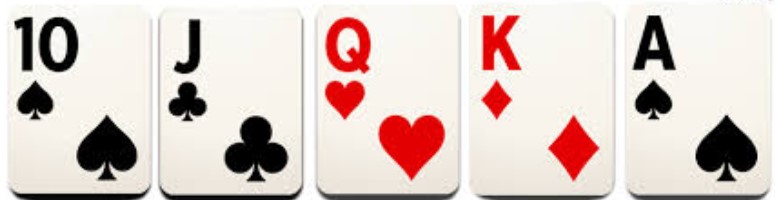
Common paths to Broadway include:
- Holding A-K and flopping Q-J-10
- Holding K-Q and catching A-J-10 on board
- Holding A-Q and seeing K-J-10 appear
Be cautious: if the board is suited (e.g., Q♠ J♠ 10♠), your unsuited Broadway may be second-best to any flush. Always assess flush and full house potential before committing your stack.
Never assume Broadway is the nuts on a paired or suited board. A flush or full house is often already made.
Omaha: Broadway Is Common—But Often Second-Best
In Pot-Limit Omaha, Broadway straights happen constantly due to four-hole-card combinations. But multiway pots mean someone likely holds a flush or full house. Worse, if the board shows Q♠ J♠ 10♠ 5♦, an opponent with K♠ 9♠ has a straight flush—annihilating your Broadway.
For more on Omaha drawing power, see what is a wrap in Omaha poker.
In Omaha, stacking off with only Broadway on a three-suited board is a high-risk play. You’re often behind a stronger hand.
When Is Broadway Actually the Nuts?
Your ace-high straight is the absolute best hand only when:
- The board is rainbow (no flush possible)
- No pair appears on the board (no full house)
- No four-to-a-straight-flush exists
Example: On K♦ Q♣ J♥ 10♠ 3♦, your A-9 gives you the nut straight—and likely the best hand. But on K♠ Q♠ J♠ 10♠ 2♣, even A♠ x♠ is vulnerable to straight flushes.
Always ask: “What beats my Broadway on this board?” If nothing does, bet confidently.
Sharpen your board-reading with how to read the board in poker.
The Wheel: When the Ace Makes the Weakest Straight
While Broadway represents the peak of straight strength, the ace also enables poker’s lowest possible straight: A-2-3-4-5, universally known as “the wheel.” This hand is technically a straight, but it loses to every other straight—from 6-7-8-9-T upward.

In standard Texas Hold’em, the wheel is a modest hand—often dominated on boards that connect well (e.g., if the board is 2-3-4-5-9, many players will hold 6-x for a higher straight). However, in Hi-Lo split games, the wheel becomes a powerhouse: it’s the best possible low hand and can simultaneously win the high half if it forms a straight or flush.
Crucially, players sometimes confuse the wheel with a strong hand in Hold’em and overvalue it. For example, holding A-2 on a 3-4-5 board gives you the wheel—but if an opponent holds 6-7, they have a six-high straight that beats you. Always verify whether your low straight is actually best.
Calling big river bets with the wheel on a dry board in Hold’em is risky. Unless the board is extremely low (e.g., A-2-3-4-7), a higher straight likely exists.
For more on split-pot dynamics, see hi-low hands in poker.
Strategic Play: Value, Bluffing, and Pot Control
On dry, rainbow boards, bet Broadway for value. Recreational players often call with lower straights (e.g., K-Q-J-10-9) or sets that are now second-best.
On wet boards, consider checking back or betting small to avoid bloating a pot you might lose. Don’t let the prestige of “Broadway” override logic.
In position with the nuts on a dry board, lead the turn or river to extract value from worse straights and two-pair hands.
Turn and River Considerations
Many players complete Broadway on the river. If your opponent has been barreling, they may have a weaker hand like top pair—and will call a value bet. But if the river pairs the board (e.g., a second king), your straight may now lose to a full house.
Master these critical streets with turn and river in poker: how to play the toughest streets.
Common Mistakes to Avoid
- Confusing Broadway with the wheel—they’re different hands with different strengths
- Overvaluing Broadway on suited boards
- Stacking off in Omaha without nut potential
- Ignoring board pairing on the river
- Overvaluing the wheel in Hold’em when higher straights are possible
Calling a huge river shove with Broadway on a paired, suited board is a classic error. You’re likely behind a full house or flush.
Broadway vs. Other Strong Hands
Broadway loses to:
- Any flush
- Any full house
- Four of a kind
- Straight flush or royal flush
For deeper comparisons, see what is a full house in poker and what is four of a kind in poker.
Tournament Dynamics and ICM
In tournaments, Broadway can win or lose your stack. Near the bubble, avoid overcommitting unless you’re certain you’re ahead. Survival often outweighs the value of a half-pot win.
Your decision should also reflect your ROI and long-term strategy—not just the hand you hold.
Position and Opponent Profiling
In position, you control pot size and extract more value. Out of position, you guess—and often underbet. Use position at the poker table to your advantage.
Also, study opponents: do they overvalue top pair? Do they fold to river aggression? Improve your reads with how to read your opponents in poker.
Advanced Insight: Broadway and the Wheel in Hi-Lo Games
In Omaha Hi-Lo, Broadway rarely wins the low—but it can win the high. However, if you hold A-2 along with Broadway cards, you might scoop both halves: A-2-3-4-5 (the wheel) for low, and a strong high hand (e.g., A-K-Q) for high. This dual threat makes A-2-K-Q one of the most powerful starting hands in Hi-Lo.
Never assume A-K-Q-J-10 is relevant for low—it isn’t. Only hands with A-2 through A-5 can qualify for low, and the wheel is the best of them.
“Broadway wins when you know it’s best—and loses when you forget the ace can also make the wheel.”
Final Word: Respect the Ace’s Duality
The ace-high straight is powerful—but not infallible. Its strength depends entirely on board texture, opponent range, and game type. Never let its name fool you: “Broadway” sounds glamorous, but it’s just another hand until you verify it’s the best.
And always remember: the same ace that gives you the strongest straight can also form the weakest. Master both—and you’ll outplay those who see only one side of the coin.