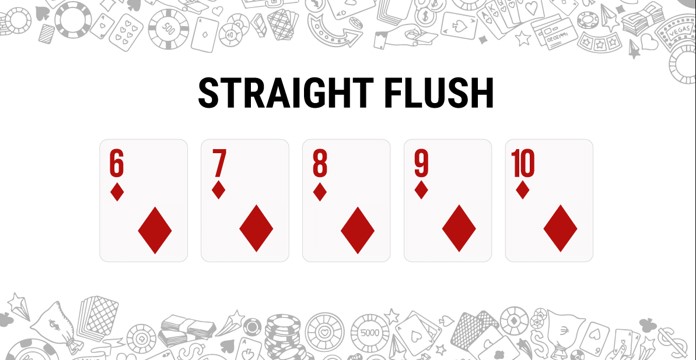
The straight flush sits just below the royal flush in poker’s hand hierarchy, making it the second strongest possible hand. It’s a five-card sequence of the same suit—like 7♠ 8♠ 9♠ 10♠ J♠—and it beats every other combination except the highest straight flush, which is the royal flush itself. Despite its rarity, knowing how to handle a straight flush correctly can turn a lucky moment into a massive pot win.
In this article, we’ll break down how the straight flush works across different poker variants, how to recognize its potential early, and—most importantly—how to extract maximum value when you actually hit it. We’ll also cover common misplays, equity considerations, and why sometimes your “monster” hand is actually vulnerable.
- What Exactly Is a Straight Flush?
- Straight Flush vs. Royal Flush: What’s the Difference?
- How Likely Is It to Hit a Straight Flush?
- Straight Flush Draws: The Hidden Path to Power
- Recognizing Backdoor Straight Flush Potential
- Playing a Made Straight Flush: Maximizing Value
- Bet Sizing for Maximum Profit
- Straight Flushes in Different Poker Variants
- Texas Hold’em
- Pot-Limit Omaha
- Stud and Draw Games
- Common Mistakes with Straight Flushes
- When to Fold to a Suspected Straight Flush
- Final Thoughts: Respect the Rarity, Master the Value
What Exactly Is a Straight Flush?
A straight flush consists of five consecutive cards all of the same suit. Unlike a regular straight or flush, both conditions must be met simultaneously. For example, 4♥ 5♥ 6♥ 7♥ 8♥ is a straight flush, but 4♥ 5♠ 6♥ 7♥ 8♥ is just a straight, and 4♥ 5♥ 7♥ 9♥ J♥ is only a flush.
In standard poker hand rankings, the straight flush outranks four of a kind, full houses, flushes, and straights. Only the royal flush—an ace-high straight flush—beats it. That means even a king-high straight flush (9♠ 10♠ J♠ Q♠ K♠) loses only to A♠ K♠ Q♠ J♠ 10♠.
There are 36 possible straight flush combinations in a standard 52-card deck, excluding the four royal flushes. That’s just 0.00139% of all possible 5-card hands—making it incredibly rare.
Straight Flush vs. Royal Flush: What’s the Difference?
Technically, a royal flush is just a type of straight flush—the highest one. But in practice, poker communities treat them as separate due to their prestige and payout implications (especially in video poker or casino side bets).
From a strategic standpoint, however, both hands are played the same way: you aim to extract as much value as possible. The key difference is that opponents are even less likely to believe you have a royal flush, which can make it slightly more deceptive—but also harder to get paid off in some situations.
Can you lose with a straight flush? Yes—but only to a higher straight flush. In community card games, if two players both hold straight flushes, the one with the highest top card wins.
How Likely Is It to Hit a Straight Flush?
In Texas Hold’em, hitting a straight flush by the river is extremely unlikely. Your odds depend heavily on your starting hand and the board texture. Holding two suited connected cards like 8♦ 9♦ gives you the best shot, but even then, your chance of making a straight flush by the river is only about 0.027% (roughly 1 in 3,600 hands).
In Pot-Limit Omaha, your chances improve significantly because you hold four hole cards. With hands like 7♠ 8♠ 9♠ T♠, you can form multiple straight flush combinations depending on the board. Still, it remains a rare occurrence even in Omaha.

Track your hands over time using software like Hold’em Manager. You’ll likely see that you hit a straight flush only a few times a year—even as a high-volume player.
Straight Flush Draws: The Hidden Path to Power
While the made straight flush is rare, its draws are more common—and far more actionable. A straight flush draw combines a straight draw and a flush draw using overlapping cards. For example, holding J♠ T♠ on a 9♠ 8♠ 2♦ board gives you both an open-ended straight draw and a flush draw—plus the chance to hit the straight flush itself.
These combos are sometimes called “double draws” or “monster draws.” They can yield up to 15+ outs: 9 for the flush, 8 for the straight, minus overlaps, plus the specific cards that complete the straight flush.
When you have a straight flush draw, you often have more equity than top pair or even trips. Play these hands aggressively, especially in position.
For more on drawing hands, see our guide to straight draws in poker, which explains how these concepts intersect with flush potential.
Recognizing Backdoor Straight Flush Potential
Even a backdoor straight flush draw—requiring two specific cards on turn and river—can influence hand selection. For example, A♠ 2♠ on a 3♠ 7♦ K♣ flop doesn’t look strong, but it has a backdoor path to the wheel straight flush (A-2-3-4-5 of spades).
While this draw alone isn’t enough to justify calling big bets, it adds hidden equity that can tip the scales in marginal spots—especially when combined with nut flush potential or overcards.
Don’t overvalue backdoor straight flush draws. They contribute less than 1% equity and should never be your primary reason to continue in a hand.
Playing a Made Straight Flush: Maximizing Value
When you actually make a straight flush, your main goal shifts from survival to extraction. The challenge? Most opponents won’t put you on such a rare hand, so they’ll often call with weaker holdings like sets, two pair, or regular flushes.
Your betting strategy depends on board texture and opponent tendencies. On a wet board like 8♠ 9♠ T♠ 2♥, a king-high straight flush (J♠ Q♠) is obvious to observant players—but on a dry board like 2♠ 3♠ 4♠ K♦ 7♣, your 5♠ 6♠ might go completely unnoticed.
Don’t slow-play a straight flush on coordinated boards. If the board shows three to a straight flush and you check, you risk letting opponents fold or improve to a higher one.
Bet Sizing for Maximum Profit
There’s no universal bet size—but here’s a rule of thumb: if your opponent is likely to have a strong hand (like a set or flush), bet large (⅔ to pot-sized). If they’re more likely to hold a bluff catcher or medium-strength hand, smaller bets (½ pot) may get more calls.
Always consider your opponent’s range. Recreational players often call river bets with any flush. Nits might only call with the nuts. Adjust accordingly.
If you’ve been bluffing a lot, your straight flush becomes an excellent “credibility” hand to balance your range. Bet confidently—it’s your turn to get paid.
Straight Flushes in Different Poker Variants
Texas Hold’em
In Hold’em, straight flushes almost always require both of your hole cards to contribute. Community-only straight flushes (like a board of 5♠ 6♠ 7♠ 8♠ 9♠) result in a chopped pot. Because of this, your hole cards must connect meaningfully with the board.
Pot-Limit Omaha
Omaha changes everything. With four hole cards, you can hold multiple straight flush combinations simultaneously. For instance, with 7♠ 8♠ 9♠ T♠, you can make a straight flush to the jack or the six, depending on the board.
However, beware of non-nut straight flushes. In multiway pots, someone may hold a higher one. Always ask: “Is my straight flush the absolute nuts?”
Calling big bets in Omaha with a non-nut straight flush (e.g., 6♠ 7♠ on 8♠ 9♠ T♠) is a fast track to going broke. You’re often drawing dead or severely dominated.
For deeper insight into Omaha drawing power, check out our article on wraps in Omaha poker, where combo draws like straight flush possibilities become central to strategy.
Stud and Draw Games
In Seven-Card Stud or Five-Card Draw, straight flushes are even rarer due to fewer cards and no community board. Still, when you hold four to a straight flush, it’s usually correct to chase it aggressively—especially in low-limit games where implied odds are high.
Common Mistakes with Straight Flushes
- Overestimating your hand’s uniqueness. On boards like T♠ J♠ Q♠, multiple players can have K♠ or 9♠, creating split pots or losses.
- Checking to “trap” on dangerous boards. You might win a small pot—or lose to a higher straight flush.
- Failing to adjust to opponent skill. Against strong players, your straight flush may be obvious, reducing its value.
- Chasing with weak components. Holding 2♠ 3♠ on a 4♠ 5♠ K♦ board gives you a backdoor wheel draw—but it’s rarely worth big calls.
Assuming your straight flush is always good is one of the costliest illusions in poker. Always evaluate whether a higher one is possible.
When to Fold to a Suspected Straight Flush
If the board shows four suited connectors (e.g., 7♦ 8♦ 9♦ T♦), and your opponent leads big on the river, they might have the jack or six of diamonds. In that case, even a king-high flush or a set may be beat.
Ask yourself: “Does their betting line make sense for a straight flush?” If they’ve been aggressive from the flop and the board coordinated perfectly, respect the possibility.
In deep-stack cash games, folding a full house or four of a kind to a suspected straight flush is rare—but not impossible on ultra-wet boards.
Final Thoughts: Respect the Rarity, Master the Value
The straight flush is a hand of extremes: nearly impossible to hit, yet devastating when you do. Its rarity makes it both a dream and a trap—players either overfold when they should bluff, or overvalue when they should exercise caution.
To play it well, combine board reading, opponent profiling, and disciplined bet sizing. Remember: the goal isn’t just to win the pot—it’s to win the biggest pot possible when you hold one of poker’s most powerful hands.
“The straight flush doesn’t win you money—how you play it does.”
Your actionable tip: The next time you flop a straight flush draw, don’t just call—consider raising to build a bigger pot or force folds from hands that currently beat you. Aggression turns draws into profit.