

Variance is the invisible force that makes poker both thrilling and frustrating. It’s the reason skilled players can lose for weeks—and recreational players can win big on a lucky streak. While skill determines long-term profitability, variance dictates short-term outcomes, often masking true performance for hundreds or even thousands of hands.
In this expert-level guide, you’ll learn what variance really is, how it affects different poker formats, and—most importantly—how to manage it through proper bankroll strategy, emotional control, and realistic expectations. Whether you play cash games, MTTs, or SNGs, mastering variance is essential for survival and sustained success.
- What Is Variance in Poker?
- Why Variance Is Higher in Tournaments Than Cash Games
- The Nature of MTT Payout Structures
- Stack Dynamics and All-In Equity
- Quantifying Variance: Standard Deviation & Expected Outcomes
- How to Manage Variance: Practical Strategies
- 1. Bankroll Management Is Non-Negotiable
- 2. Focus on Process, Not Results
- 3. Diversify Your Game Mix
- Variance and Tilt: The Dangerous Feedback Loop
- Variance Myths Debunked
- Advanced Tips: Using Variance to Your Advantage
- Calculating Poker Variance
- Conclusion: Embrace Variance as Part of the Game
What Is Variance in Poker?
Variance measures how much your actual results deviate from your expected value (EV). In simple terms, it’s the statistical “noise” caused by luck. Even if you make perfect decisions, you won’t win every pot—especially when you’re involved in coinflip situations like pocket tens vs. AK.

Unlike games of pure skill (e.g., chess), poker includes a significant element of randomness due to shuffled cards and unknown opponent holdings. This randomness creates natural swings—upswings when luck favors you, and downswings when it doesn’t.
High-variance games (like multi-table tournaments) feature infrequent but massive payouts, leading to long dry spells. Low-variance formats (like heads-up SNGs or cash games) offer steadier, more predictable results—but still include significant swings over time.
Why Variance Is Higher in Tournaments Than Cash Games
The Nature of MTT Payout Structures
In cash games, every hand is independently valued. Win a pot, and you profit immediately. In tournaments, you only get paid if you finish in the money—and often only the top 10–15% of players cash. This top-heavy payout structure amplifies variance dramatically.
For example, a skilled MTT player with a solid 50% ROI might still go 50 tournaments without a cash due to bad luck at key moments—like losing a flip on the bubble. Meanwhile, a lucky amateur might win once and appear “better” in the short term.
Stack Dynamics and All-In Equity
Tournaments force players into short-stack situations where decisions hinge on flips and gutshots—increasing variance. In contrast, cash games allow you to rebuy, avoid marginal spots, and realize your equity more consistently.
This is why winrate in cash games stabilizes faster (after ~10,000 hands), while MTT ROI requires 300+ tournaments for statistical reliability.
Quantifying Variance: Standard Deviation & Expected Outcomes
While ROI or bb/100 shows your average performance, standard deviation (SD) reveals how volatile your results are. Most poker tracking tools (e.g., PokerTracker) display SD automatically.
- Cash games (NLHE): Typical SD = 80–100 bb/100
- MTTs: SD can exceed 500% ROI due to rare big wins
Using SD, you can model expected result ranges. For example, a 5 bb/100 winner over 10,000 hands might reasonably swing between +100 bb and –50 bb purely due to variance—despite playing perfectly.
Ignoring this statistical reality leads players to misattribute downswings to “bad play” or “rigged sites,” when in fact, they’re just experiencing expected randomness.
How to Manage Variance: Practical Strategies
1. Bankroll Management Is Non-Negotiable
Your bankroll is your shock absorber. Without proper sizing, variance will bust you before skill can shine.
- Cash games: 50–100 buy-ins for NLHE
- MTTs: 150–200 buy-ins for serious grinders
- SNGs: 50–75 buy-ins
If you’re grinding MTTs with only 20 buy-ins, even a modest downswing could force you to move down—or quit. Proper bankroll sizing ensures you survive long enough to realize your edge.
2. Focus on Process, Not Results
Stop judging sessions by profit/loss. Instead, ask: “Did I make the highest-EV decisions?” A session where you lose three coinflips but played perfectly is a win in disguise.
Review hands using EV in poker principles—not outcomes. This mindset shift reduces emotional reactions and prevents tilt in poker, which exacerbates variance-induced losses.
3. Diversify Your Game Mix
Playing only high-variance MTTs magnifies emotional and financial swings. Mix in lower-variance formats like cash games or HU SNGs to smooth your overall results.
This doesn’t mean avoiding tournaments—it means balancing your schedule so one bad MTT streak doesn’t derail your month.
Variance and Tilt: The Dangerous Feedback Loop
Downswings trigger frustration. Frustration leads to tilt—making reckless calls, over-bluffing, or chasing losses. Tilt worsens results, deepening the downswing. It’s a vicious cycle.
To break it:
- Set stop-loss limits (e.g., quit after losing 3 buy-ins in a session)
- Take breaks during losing streaks
- Meditate or exercise to reset your emotional baseline
Remember: the best players aren’t those who never lose—they’re those who lose gracefully and return with discipline.
Variance Myths Debunked
- “I’m due for a win.” Past results don’t affect future ones. Each hand is independent. This is the gambler’s fallacy.
- “Variance only hurts bad players.” Even elite pros endure brutal downswings. Phil Galfond once lost $2.8M in a single PLO challenge before recovering.
- “If I play more, I’ll win back my losses faster.” Only true if you’re +EV. If you’re losing due to poor strategy, volume accelerates ruin.
- “Rigged sites cause downswings.” Online poker is statistically verified as fair. Downswings are mathematically inevitable.
Advanced Tips: Using Variance to Your Advantage
- Exploit opponents’ variance fear: Many players tighten up during their own downswings. Attack their passivity with well-timed bluffs and blind steals.
- Time your stakes moves wisely: Move up after sustained upswings (not one big score). Move down at the first sign of stress—not after busting your roll.
- Track session metrics beyond profit: Monitor hands played, bb/100, and aggression stats. If these stay consistent during a downswing, trust the process.
- Use freerolls during dry spells: When funds are low, freerolls offer a no-risk way to rebuild without emotional pressure.
Calculating Poker Variance
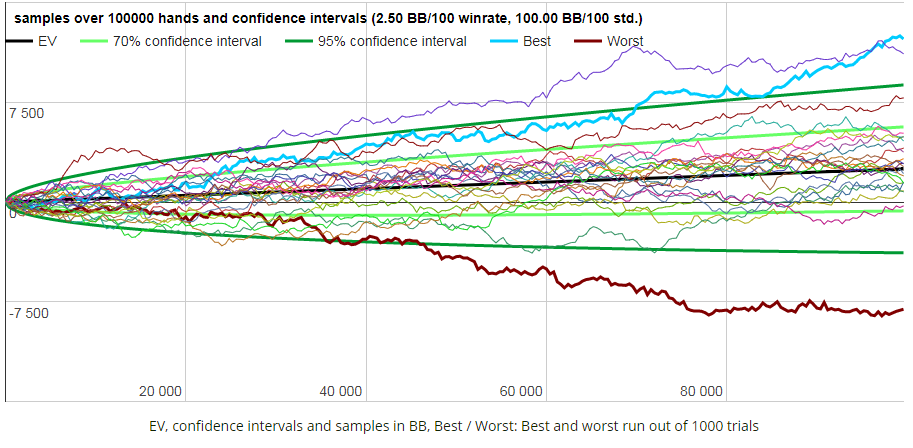
Today, we can calculate variance in poker, which can show potential losses in the worst-case scenarios. This information helps you pick the right game type for your bankroll—or set up the right bankroll size for different games and stakes. Knowing your variance helps you understand the bankroll you need to play confidently.
You can calculate poker variance with an online calculator. To use it, just fill in a few fields:
- Winrate in BB/100: Your winrate in big blinds per 100 hands, which you can check in your stats software.
- Observed Winrate (Optional): Your actual winrate, but this field can be left blank.
- Standard Deviation in BB/100: For NL Hold’em 6-max, this typically ranges from 75 to 120 BB/100. You can find this value in programs like Holdem Manager 2.
- Number of Hands to Simulate: Input the number of hands, such as 100,000.

After clicking “Calculate,” you’ll see a graph with 20 different lines showing potential results over time, including a black line (expected value, or EV), and blue and maroon lines representing the best and worst outcomes.
Conclusion: Embrace Variance as Part of the Game
Variance isn’t your enemy—it’s the tax you pay for playing a game that rewards skill over time. The players who last aren’t the luckiest; they’re the ones who respect variance, prepare for it, and refuse to let it dictate their mindset.
Start today: review your bankroll size, set emotional boundaries, and refocus on decision quality over short-term results. Do that consistently, and variance won’t break you—it will reveal you as the winner you are.


