

The big blind is the most challenging position at the poker table—forced to act first post-flop, often out of position, against a range that opened the betting. Yet it’s also one of the most profitable spots for skilled players, offering better pot odds and opportunities to counter-steal against aggressive openers. The key is knowing when to defend, with what hands, and how to play post-flop without bleeding chips.
In this guide, we’ll move beyond outdated “fold everything” advice and dive into modern, position-aware defense strategies grounded in GTO principles and exploitative adjustments. Whether you’re facing a button min-raise or an early-position shove, you’ll learn how to make mathematically sound, context-aware decisions that protect your stack—and grow it.
- Why Defending the Big Blind Matters
- Defense Ranges by Opponent Position
- The Math Behind the Call
- Post-Flop Play: The Real Challenge
- When to 3-Bet from the Big Blind
- Tournament-Specific Adjustments
- Common Big Blind Mistakes
- Advanced Insight: Exploiting Opponent Tendencies
- The Role of Rake and Winrate
- Practical Drill: The Big Blind Log
- Final Word: Defense Is Active, Not Passive
Why Defending the Big Blind Matters
Every time you post the big blind, you’ve already invested 1BB into the pot. When someone raises, you’re getting immediate pot odds to call—often 3-to-1 or better. That means you don’t need a premium hand to profitably continue. In fact, folding too much from the big blind is one of the most common leaks among recreational players.
Modern solvers show that against a standard 2.5x open from the button, the big blind should defend 50–60% of hands—including suited connectors, small pairs, and even some offsuit broadways. Against tighter openers (like UTG), you tighten up—but rarely fold more than 70% of your range.
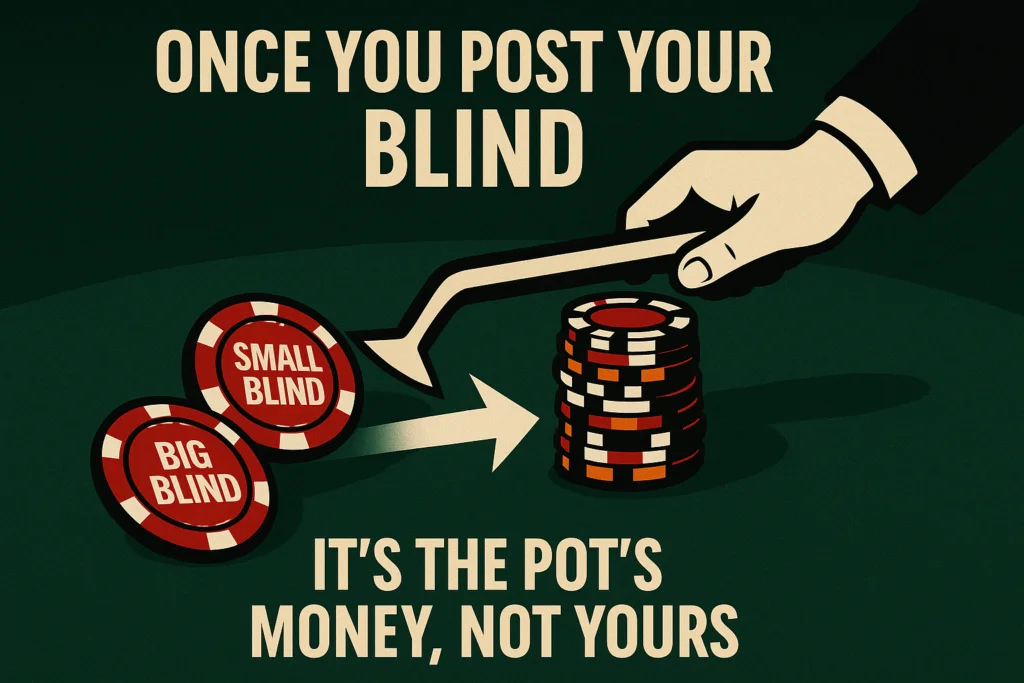
Your big blind is not dead money. It’s an investment that gives you the right to call with a wide range—especially in position or against loose openers.
Defense Ranges by Opponent Position
Your defending range should shift dramatically based on where your opponent opened from:
- vs. Button or Cutoff (loose opens): Defend widely—50–65%. Include hands like 76s, T4s, A2o, K9o. These have playability or blockers.
- vs. Hijack or MP: Defend 40–50%. Focus on suited hands, pairs, and broadway cards.
- vs. UTG or UTG+1 (tight opens): Defend 25–35%. Stick to strong pairs, suited aces, and broadway connectors. Avoid marginal offsuit hands.
Use blockers to refine your range. A5s defends better than 84o against a button open because the ace blocks AA, AK, and AQ in their calling range.
The Math Behind the Call
When facing a 2.5x open, the pot is 3.5BB (1BB SB + 1BB BB + 2.5BB raise – 1BB you already posted). To call, you’re investing 1.5BB more to win 3.5BB—giving you 2.33-to-1 pot odds. You need just ~30% equity to call profitably.
Most hands—even 98o or J3s—have more than 30% equity against a wide opening range, especially when you’ll be in position post-flop. In tournaments with antes, your pot odds improve even further, making defense even more mandatory.
Don’t ignore stack depth. With 20BB or less, shift toward shoving or folding. With 50BB+, calling to realize equity becomes highly profitable.
Post-Flop Play: The Real Challenge
Calling preflop is only the first step. How you play the flop, turn, and river determines whether your defense was +EV. Key principles:
- In position: Bet for value with top pair+, check back with draws or weak pairs to control pot size.
- Out of position: Check most hands. Bet only with strong value or as a bluff on dry boards.
- On wet boards: Don’t over-defend. If the flop is J♠ T♠ 7♦ and you hold 98o, you’re often dominated—checking and folding to aggression is correct.
Calling a flop c-bet with second pair out of position, then folding to a turn bet, is a slow leak. Either defend with a plan to continue, or fold preflop.
Master these decisions with how to play post-flop.
When to 3-Bet from the Big Blind
Not all defense is calling. Sometimes, a 3-bet is stronger—especially as a bluff or semi-bluff. Use 3-bets when:
- Your opponent folds to 3-bets frequently (>50%)
- You hold hands with blockers (A5s, K4s) or strong draws (87s)
- Stacks are deep (40BB+), allowing post-flop maneuvering
Value 3-bets include TT+, AQ+, AK. Bluff 3-bets are often Axs, Kxs, or suited connectors with good equity.
Against a button who opens 60% and folds to 3-bets 60% of the time, 3-betting A3s is pure profit. You win the pot immediately 60% of the time—and have equity when called.
Tournament-Specific Adjustments
In tournaments, blinds escalate and antes inflate pots—making big blind defense even more critical. Near the bubble, tighten slightly if survival is key. But in early levels, defend aggressively to avoid blinding out.
In MTTs, your ROI depends on chip accumulation. Folding 70% of hands from the big blind guarantees gradual death.
Should you defend wider in tournaments than cash games? Yes—because antes increase pot odds, and chip preservation is a constant pressure. A hand like Q5s that folds in $1/$2 cash may call in a 500/1000 MTT with antes.
Common Big Blind Mistakes
- Over-defending vs. tight openers—calling UTG raises with 64o is suicide
- Under-defending vs. loose openers—folding A9o to a button raise leaks massive EV
- Calling with no post-flop plan—“I’ll see a flop” is not a strategy
- Ignoring position post-flop—betting out of position with marginal hands bloats pots you can’t win
Calling a 3-bet from UTG with 77 because “I have a pair” is a classic error. You’re likely dominated and out of position—fold preflop.
Advanced Insight: Exploiting Opponent Tendencies
While GTO gives a baseline, real profit comes from adjustment:
- If your opponent rarely c-bets, check-call more often—you’ll get to showdown cheaply.
- If they c-bet 100%, bluff-raise dry flops with backdoor draws.
- If they fold to flop raises, add more check-raises with marginal hands.
Track how often opponents continuation bet after you call their open. If it’s below 50%, your defense becomes even more profitable—you’ll see more free turns.
Sharpen your reads with how to read your opponents in poker.
The Role of Rake and Winrate
In high-rake games (common at microstakes), marginal defense hands lose value. A hand with 32% equity might be -EV after rake. Always factor in what is rake in poker when deciding close calls.
Similarly, if your winrate is low, over-defending can accelerate downswings. Solid post-flop play is a prerequisite for wide defense ranges.
Practical Drill: The Big Blind Log
For one week, log every big blind hand:
- Opponent position
- Your hand
- Your action (fold/call/3-bet)
- Result
After 50 hands, review: Are you folding too much to late positions? Calling too wide vs. early?
“The big blind isn’t a prison—it’s a fortress. Defend it wisely, and you’ll outlast the aggressors.”
Final Word: Defense Is Active, Not Passive
Defending the big blind isn’t about hoping to flop a set—it’s about strategic range construction, post-flop discipline, and exploiting opponent weakness. The best players treat the big blind as a dynamic position, not a dumping ground for weak calls.
Start by defending wider against late positions. Then focus on clean post-flop lines. Over time, what was once a losing spot will become one of your most consistent sources of profit.
Your next session: defend at least 50% of hands vs. button opens. Even if you fold the flop 70% of the time, the sheer frequency of calls will make your overall strategy profitable. Trust the math.


