Rake is the commission poker rooms take from every cash game pot or tournament entry. It’s how online sites and live cardrooms make money—and it’s also the silent thief that can erase your edge if you’re not careful. While beginners often ignore rake, winning players treat it as a core part of their strategy, tracking its impact on winrate, ROI, and bankroll growth.
In this guide, we’ll break down exactly what rake is, how it’s collected across different formats, why it matters more than you think, and—most importantly—how to reduce its toll on your bottom line. Whether you play $0.02/$0.05 online or $2/$5 live, understanding rake is non-negotiable for long-term profit.
- What Exactly Is Rake?
- How Rake Is Collected: Cash Games vs. Tournaments
- Cash Game Rake Structures
- Tournament Rake (Also Called “Vig” or “Juice”)
- Why Rake Matters: The Math Behind the Leak
- Rake and Winrate: The Hidden Connection
- Rakeback and Rewards: How to Get Some Rake Back
- Strategic Adjustments to Minimize Rake Impact
- Rake in Live vs. Online Poker
- Rake and Game Selection
- Common Rake Myths
- Rake, Variance, and Downswings
- Advanced Tip: Rake and GTO Strategy
- Final Word: Rake Is Part of the Game—Master It
What Exactly Is Rake?
Rake is the fee operators charge to run poker games. In cash games, it’s typically a percentage of the pot (capped at a maximum amount). In tournaments, it’s built into the buy-in—e.g., a $10+$1 tournament means $10 goes to the prize pool and $1 is rake.
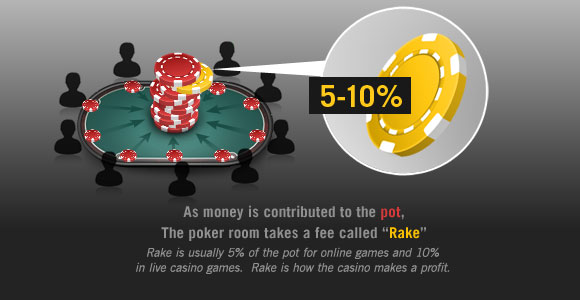
For example, in a $1/$2 NLHE cash game online, a $20 pot might generate $1 in rake (5%), while a $100 pot might still only generate $3 (the cap). Live games often use a time-based fee instead—e.g., $5 every 30 minutes—regardless of pot size.
Rake is not optional. Every poker room charges it, and it’s the primary reason why most players lose money over time—even if they’re skilled.
How Rake Is Collected: Cash Games vs. Tournaments
Cash Game Rake Structures
Online cash games usually use pot rake: a percentage (3–10%) taken from the pot after each hand, up to a cap (e.g., $3 or $5). Some sites use a deal drop method, where a fixed amount is taken before the flop. Live games often use time collection, charging players by the hour.
Importantly, rake is only taken when a flop is dealt. If players fold pre-flop, no rake is collected in most online rooms. This incentivizes aggressive pre-flop play—but also creates hidden costs for frequent flop play.
Don’t assume small stakes are “cheap.” A 5% rake on micro-stakes with a low cap can represent a massive percentage of average pot size—hurting your winrate more than at higher stakes.
Tournament Rake (Also Called “Vig” or “Juice”)
In tournaments, rake is baked into the buy-in. A $55 tournament might be listed as $50+$5—the $5 is the rake. The higher the rake percentage, the harder it is to achieve positive ROI.
For instance, a $10+$2 tournament has a 16.7% rake, while a $100+$9 tournament has only 9% rake. Over time, that difference dramatically impacts profitability—especially for grinders playing thousands of events.
Always compare rake percentages, not just buy-ins. A $22 tournament with $2 rake (8.3%) is better than a $20 tournament with $3 rake (13%).
Why Rake Matters: The Math Behind the Leak
Let’s say you’re a solid cash game player with a 2 big blinds per 100 hands (BB/100) winrate at $1/$2. That’s $4 per 100 hands. But if the average pot is $15 and rake is $0.75 per hand (5%), you’re paying $0.75 in rake every time you see a flop—often multiple times per 100 hands.
In tournaments, a 15% rake means you need to finish in the top 12–15% just to break even—before accounting for variance. This is why ROI is so critical: if your ROI is 10% but rake is 15%, you’re actually losing money.
For deeper analysis, see what is ROI in poker and why it matters.
Many players believe they’re winning because they cash often—but don’t account for rake. In reality, they’re grinding for free (or worse).
Rake and Winrate: The Hidden Connection
Your true winrate = gross winrate minus rake. A player earning $10/hour before rake might only make $6/hour after rake—especially in games with high rake and low average pot sizes.
To calculate your effective winrate, track both your gross earnings and total rake paid. Tools like Hold’em Manager or PokerTracker show this automatically. Without this data, you’re guessing at profitability.
Learn how to measure performance accurately in how to calculate winrate in poker.
Playing in games with high rake and weak opponents isn’t always profitable. Sometimes, a slightly tougher game with lower rake offers better hourly earnings.
Rakeback and Rewards: How to Get Some Rake Back
Most online poker sites offer rakeback—a percentage of the rake you generate, returned to you weekly or monthly. This can range from 10% to 40%, depending on the site and your status.
For example, if you pay $1,000 in rake per month and get 30% rakeback, you receive $300 back—effectively lowering your operating cost. Some sites use loyalty programs instead (e.g., points redeemable for cash), but the goal is the same: reduce net rake.
Always play at rooms offering rakeback or loyalty rewards. Over a year, this can turn a breakeven player into a profitable one.
Bonus offers can also offset rake—see bonus hunting in poker for advanced tactics.
Strategic Adjustments to Minimize Rake Impact
- Play fewer marginal hands: Every flop you see costs rake. Tighten your range slightly in high-rake games.
- Avoid multi-way pots with weak holdings: More players = bigger pot = more rake, but your equity may not justify it.
- Target games with lower rake caps: A $0.50 cap at $0.25/$0.50 is better than a $3 cap at $1/$2 if pots are small.
- Fold pre-flop more often: No flop = no rake. This is especially valuable in heads-up or short-handed play.
In tournaments, avoid high-rake formats like $10+$5 unless the field is extremely soft. Seek out overlay tournaments or those with guaranteed prize pools.
Rake in Live vs. Online Poker
Live games often feel “rake-free” because you pay time or a fixed drop—but the cost is real. A $5/hour time fee adds up fast if you’re not winning consistently. Online, rake is more transparent but taken more frequently (per hand vs. per hour).
Online also offers tools to track and offset rake (rakeback, stats). Live players must estimate manually—making it easier to overlook.
Is live poker more expensive than online? Often, yes—because time fees compound, and you play fewer hands per hour, reducing your ability to overcome rake through volume.
Rake and Game Selection
Smart players choose tables based not just on opponent skill—but on rake efficiency. A table full of fish with 10% rake may be worse than a table with decent players and 3% rake.
Use HUD stats to calculate **EV per 100 hands after rake**. Some tracking software even includes “rake-adjusted winrate” to help with this.
Game selection ties directly into how to win at poker—profitability starts before you sit down.
Common Rake Myths
- “Rake doesn’t affect me—I play tournaments.” False. Tournament rake directly lowers your ROI.
- “Only winning players care about rake.” Wrong. Losing players bleed faster with high rake.
- “All $100 tournaments have the same rake.” No—some are $90+$10 (10%), others $95+$5 (5%). Huge difference.
Ignoring rake is like driving with a slow tire leak—you’ll get where you’re going, but you’ll run out of air before you realize it.
Rake, Variance, and Downswings
High rake increases the required bankroll. Why? Because your net winrate is lower, so downswings hit harder. A player with 5 BB/100 gross winrate and 2 BB/100 rake has only 3 BB/100 net—requiring a larger cushion to survive variance.
This is especially true in cash games, where rake is continuous. In tournaments, high rake means fewer cashes are profitable, extending the expected downswing length.
Understand the emotional toll in downswings in poker.
Advanced Tip: Rake and GTO Strategy
Game Theory Optimal (GTO) solvers assume **no rake**. But in real games, rake changes optimal frequencies. For example, you should bluff less often in high-rake games because the pot is smaller relative to your bet size—reducing fold equity.
Some advanced solvers now include rake parameters. If you’re serious about GTO play, always input the correct rake structure—otherwise, your strategy is fundamentally flawed.
In high-rake environments, a slightly exploitative strategy that avoids marginal spots often beats pure GTO.
Explore theory in GTO poker strategy.
Final Word: Rake Is Part of the Game—Master It
Rake isn’t optional, but it is manageable. The best players don’t just try to beat opponents—they also beat the rake. They choose low-rake games, claim rakeback, tighten marginal spots, and track net profitability religiously.
Ignoring rake is the fastest way to turn a small edge into a long-term loss. Respect it, measure it, and minimize it—and you’ll keep more of every dollar you earn.
“In poker, the real opponent isn’t always at the table—it’s the rake.”
Your next session: check your poker site’s rake structure and your current rakeback deal. If you’re not enrolled in a rewards program, sign up today—it’s free money you’re leaving on the table.