
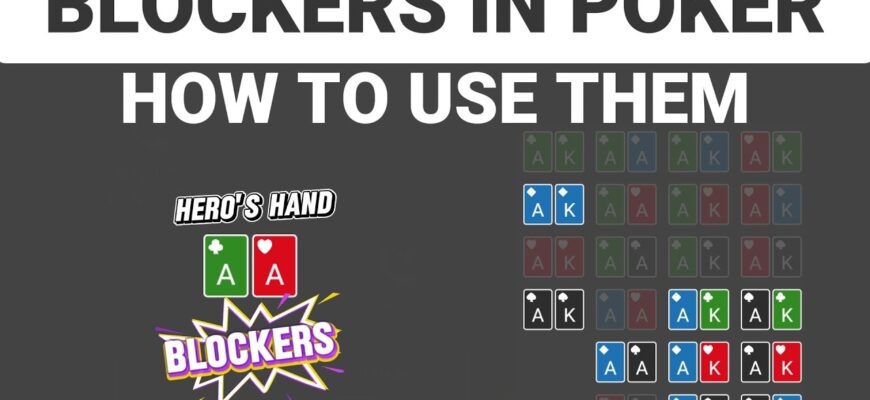
In poker, a blocker is a card in your hand that reduces the likelihood your opponent holds certain strong combinations. Holding the ace of spades makes it less likely someone has the nut flush. Carrying the king of hearts reduces the chance of a king-high straight. These subtle reductions in opponent range aren’t just theory—they’re practical tools that shape every bluff, value bet, and fold you make.
Yet most players ignore blockers or misuse them. In this guide, we’ll break down how blockers work in real games, how to apply them on every street, and—most importantly—how to use them to make better decisions under pressure. Whether you play Hold’em, Omaha, or mixed games, mastering blockers will give you a consistent edge over opponents who think only in hand strength, not card removal.
- What Is a Blocker in Poker?
- Blockers and Hand Combinatorics
- Using Blockers to Improve Bluffing
- Blockers in 3-Bet and 4-Bet Bluffs
- Blockers in Calling Decisions
- Blockers on the Turn and River
- Common Blocker Mistakes
- Blockers in Omaha and Other Variants
- Advanced Tip: GTO and Blocker Effects
- Practical Drill: The Blocker Journal
- Final Word: Blockers Are Silent Signals
What Is a Blocker in Poker?
A blocker is any card you hold that “blocks” or removes combinations from your opponent’s possible range. For example, if you hold A♠ K♠ on a board of Q♠ J♠ 5♦, you block both the nut flush (A♠) and Broadway straights (A♠ K♠). This means your opponent is less likely to have those exact hands—giving you more room to bluff or call down.
Blockers work because poker uses a finite 52-card deck. Every card you see—yours or on the board—reduces the total pool. When you hold a blocker, you’re not just playing your hand—you’re actively constraining your opponent’s possible holdings.
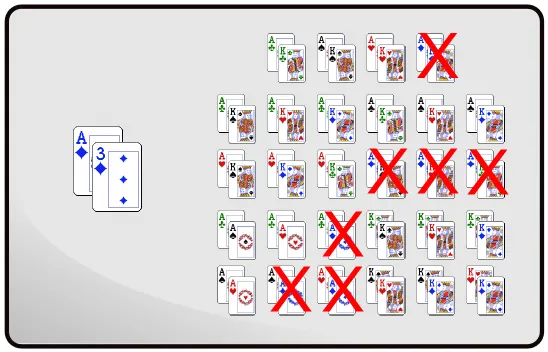
Blockers don’t eliminate hands—they reduce their probability. Holding one ace doesn’t make AA impossible, but it cuts the number of AA combos from 6 to 3.
Blockers and Hand Combinatorics
Hand reading isn’t just about what hands your opponent might have—it’s about how many ways they can have them. This is where combinatorics (combos) and blockers intersect.
Example: On a flop of A♦ T♣ 3♠, your opponent’s range for top pair includes A-K, A-Q, A-J, A-9, etc. But if you hold A♥ 7♦, you block all ace-high combos. Instead of 12 possible A-K combos, there are now only 8 (since one ace is in your hand).
This affects your decisions: bluffing becomes safer (they’re less likely to have Ax), and calling down with second pair becomes riskier (they’re more likely to have non-ace hands like sets or draws).
Always consider how your hole cards remove combos from your opponent’s range—especially when deciding whether to bluff or call on scare cards.
Using Blockers to Improve Bluffing
Bluffing is most effective when your hand blocks the very hands your opponent would call with. For instance, on a Q♠ J♠ T♥ board, bluffing with A♠ 9♦ is stronger than bluffing with 8♦ 7♦—because the ace blocks the nut straight (A-K), and the 9 blocks Q-9 or J-9 straights.
Similarly, on a three-flush board like K♠ 8♠ 4♠, holding A♠ makes your bluff more credible. Your opponent knows you could have the flush—but more importantly, you block their ability to hold it too. This gives your all-in more fold equity.
The best river bluffs often include blockers to the nuts. They make your range look stronger while simultaneously weakening your opponent’s calling range.
Blockers in 3-Bet and 4-Bet Bluffs
Blockers matter preflop too. When you 3-bet bluff from the button, hands like A-5 suited are better than 7-2 offsuit—not just because of playability, but because the ace blocks AA, AK, and AQ in your opponent’s calling range.
In 4-bet bluffing, hands like K-Q block AA, KK, and AK—making them excellent semi-bluffs that also have showdown value if called.
Blockers in Calling Decisions
Blockers also help you fold correctly. If you hold 9♠ 8♠ on a T♠ 7♠ 2♦ board and face a big bet, you block some of your own straight draws—but more importantly, you **don’t** block the nut flush or higher straights. This means your opponent is more likely to have a hand that beats you.
Conversely, if you hold K♠ Q♠ on the same board, you block the Broadway straight (A-J) and the nut flush draw. This makes it more likely your opponent is bluffing or holding a weaker draw—so calling becomes correct.
Don’t use blockers to justify hero calls. Just because you block one strong hand doesn’t mean your opponent isn’t holding another.
Sharpen your read accuracy with how to read your opponents in poker.
Blockers on the Turn and River
As more cards are revealed, blockers become even more precise. On the river, you know all five community cards—so you can calculate exactly which combos remain possible.
Example: Board is A♣ K♦ Q♥ (Broadway). You hold A♠ 2♦. Your ace blocks AA and A-high straights. If your opponent shoves, they’re less likely to have the nut straight (A-10)—but they could still have K-Q or Q-J. However, if you held 9♠ 8♠ instead, you wouldn’t block any Broadway combos—making a call much riskier.
On paired boards, blockers to full houses matter. Holding one king on a K-K-7-7 board reduces the chance your opponent has K-7 for kings full—but not 7-7 for sevens full.
For deeper street-by-street strategy, see turn and river in poker: how to play the toughest streets.
Common Blocker Mistakes
- Overvaluing weak blockers: Holding one spade on a two-spade board doesn’t meaningfully block flushes.
- Ignoring combo reduction: Not adjusting for the fact that your hand cuts opponent combos in half.
- Bluffing without nut blockers: Bluffing with 6-5 on a Q-J-T board gives no protection against the nut straight.
- Calling with unblocked ranges: Calling big bets when you hold no cards that reduce the likelihood of monster hands.
Assuming “I have a blocker, so I can bluff” without considering board texture or opponent tendencies is a fast way to burn chips.
Blockers in Omaha and Other Variants
In Pot-Limit Omaha, blockers are even more powerful—because players hold four cards, and ranges are wider. Holding A♠ K♠ Q♦ J♦ on a T♠ 9♠ 2♦ board blocks nearly all nut straight and flush combinations, making semi-bluffs extremely effective.
However, be cautious: in Omaha, your opponent may still have redraws or stronger wraps. Always consider whether your blockers actually matter against their likely range.
Do blockers work in Stud or Draw games? Yes—but less precisely, since you see fewer opponent cards. Still, holding a visible ace reduces the chance someone has a pair of aces.
Advanced Tip: GTO and Blocker Effects
Modern solvers incorporate blockers into every decision. In GTO strategy, bluffing ranges on the river are carefully constructed to include hands that block the nuts—making them less exploitable.
For example, in a solver solution for a Q-J-T board, the optimal bluffing range includes A-9 and K-9—but not 8-7. Why? Because A and K block the nut straight (A-K), while 8-7 does not. This subtle difference makes the bluff more credible and harder to call.
You don’t need to memorize solver outputs—but understanding that strong bluffs block strong calls will align you with GTO principles.
Explore the foundation in GTO poker strategy.
Practical Drill: The Blocker Journal
To internalize blockers, keep a simple journal:
- After each session, pick one hand where you bluffed or called.
- Write down your hole cards and the board.
- List which strong hands you blocked—and which you didn’t.
- Ask: “Did my blockers justify my action?”
Over time, you’ll develop an intuitive sense for when blockers matter most.
Start with river decisions—they’re the clearest. Did you bluff with a nut blocker? Did you fold because you lacked one? This single habit will rewire your hand reading.
Final Word: Blockers Are Silent Signals
Blockers don’t shout—they whisper. They won’t tell you exactly what your opponent holds, but they’ll quietly eliminate possibilities and tilt probabilities in your favor. The best players don’t just ask “What could they have?”—they ask “What could they have, given the cards I’m holding?”
Master this question, and you’ll bluff with more confidence, call with better precision, and fold without regret. In a game of incomplete information, blockers are one of the few tools that bring you closer to the truth.
“Poker isn’t just about your cards—it’s about the cards your opponent can’t have.”


