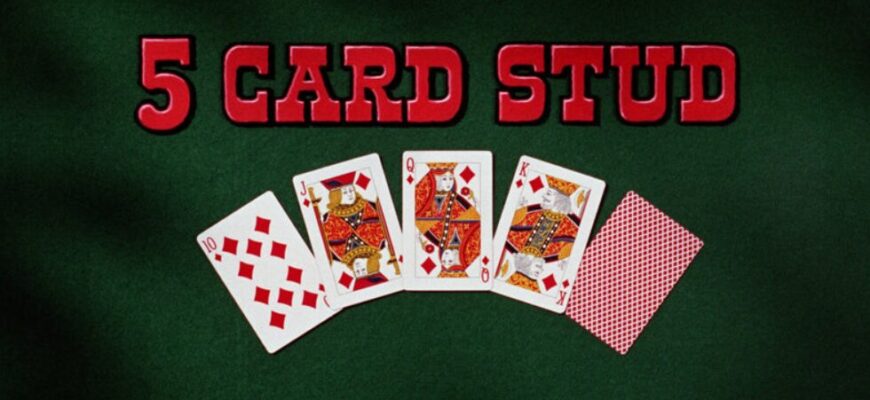
Five-Card Stud is one of poker’s oldest and most elegant variants—a game of partial information, disciplined betting, and sharp observation. Unlike Texas Hold’em or Omaha, there are no community cards; each player builds a hand from their own mix of face-up and face-down cards. This format puts a premium on reading opponents and managing limited information.
Though less common in modern online poker rooms, Five-Card Stud remains a staple in home games and mixed-game formats like HORSE. In this comprehensive guide, we’ll cover the full rules, betting mechanics, hand rankings, and strategic nuances that separate winners from the rest of the table.
- What Is Five-Card Stud Poker?
- Basic Rules and Game Flow
- Step-by-Step Deal and Betting Rounds
- Hand Rankings in Five-Card Stud
- Betting Structure: Fixed Limit Explained
- Key Strategic Concepts
- 1. Reading Opponents’ Exposed Cards
- 2. Starting Hand Selection
- 3. The Power of the Bring-In
- Common Mistakes in Five-Card Stud
- How Five-Card Stud Differs from Other Poker Variants
- Where to Play Five-Card Stud Today
- Final Thoughts: Why Stud Still Matters
What Is Five-Card Stud Poker?

Five-Card Stud is a fixed-limit poker variant where each player receives five cards: one face-down (“hole card”) and four face-up. The game is typically played with 2–8 players and uses a standard 52-card deck (no jokers). There are no blinds; instead, the player with the lowest upcard must post a mandatory ante or “bring-in” to start the action.
Because most of your hand is exposed, bluffing is riskier than in flop games—but not impossible. Skilled players use their upcards to craft believable stories, induce folds, or extract value from weaker hands. The game rewards patience, memory, and the ability to track folded cards.
Basic Rules and Game Flow
Step-by-Step Deal and Betting Rounds
Here’s how a hand of Five-Card Stud unfolds:
- Antes: All players post a small ante (e.g., $1) before cards are dealt.
- Third Street: Each player gets two cards—one down, one up. The player with the lowest upcard must post a “bring-in” (e.g., $1) or complete the bet to the minimum (e.g., $2). Betting proceeds clockwise.
- Fourth Street: Each player receives a second upcard. The player with the strongest visible hand acts first. Betting limits double (e.g., from $2 to $4 in a $2/$4 game).
- Fifth Street: Third upcard dealt. Betting continues at the higher limit.
- Sixth Street: Fourth upcard dealt. Same betting structure.
- Seventh Street (River): Final card dealt face-down. Final round of betting.
- Showdown: Remaining players reveal hands. Best five-card poker hand wins the pot.
If the deck runs out before all players receive their final card (in full-ring games), a single community card is used for all remaining players—but this is rare in Five-Card Stud, which caps at 8 players.
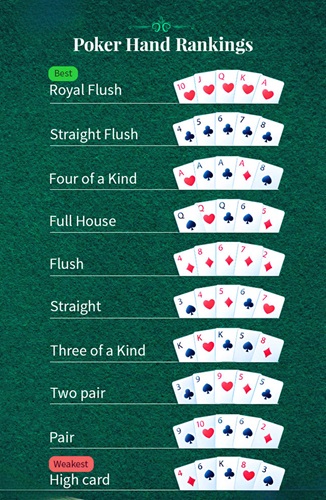
Hand Rankings in Five-Card Stud
Hand rankings follow standard poker hierarchy—from high card to royal flush. Since there are no community cards, you always use your five personal cards. This means:
- No shared nuts—your opponent can’t have the exact same hand unless suits differ.
- Flushes and straights are harder to hide, making them slightly less valuable than in Hold’em.
- Two pair or even one pair can win at showdown, especially in short-handed games.
For a full breakdown of hand strength, refer to our guide on Texas Hold’em poker hands ranked by strength—the rankings are identical across all standard variants.
Betting Structure: Fixed Limit Explained
Five-Card Stud is almost always played as a fixed-limit game. This means:
- Bets and raises on Third Street are at the “small bet” size (e.g., $2).
- From Fourth Street onward, bets and raises double to the “big bet” size (e.g., $4).
- Most games cap raises at three or four per round.
Fixed-limit structure reduces variance compared to no-limit games, making bankroll management easier. However, it also limits your ability to apply maximum pressure with large bluffs—so value betting and hand reading become even more critical.
Key Strategic Concepts
1. Reading Opponents’ Exposed Cards
Since four of your five cards are visible, opponents can easily assess your potential hand strength. Conversely, you must constantly analyze their upcards:
- Are they showing connected cards? They may have a straight draw.
- Do they have three suited cards? Beware of flushes by Sixth Street.
- If they paired their door card (first upcard), they likely have a strong hand—proceed with caution.
This skill ties directly into our guide on how to read your opponents in poker, which applies powerfully in stud formats.
2. Starting Hand Selection
Not all starting hands are equal. Strong Third Street holdings include:
- Any pair (especially hidden pairs—e.g., [7♠] 7♦)
- Ace-high with a strong kicker (A♠ K♦)
- Connected or suited cards with high potential (K♠ Q♠)
Avoid weak, unconnected, offsuit hands like 8♣ 3♦—they rarely improve and are easily dominated.
3. The Power of the Bring-In
On Third Street, the player with the lowest upcard must post a bring-in (usually half the small bet). Smart players sometimes “complete” this to the full small bet to take control of the hand and force weaker hands to fold.
Common Mistakes in Five-Card Stud
- Chasing draws too long: With only five cards, drawing to a gutshot or low flush is usually –EV. Fold early if you miss by Fourth Street.
- Overvaluing hidden pairs: A hidden pair of 5s may look strong, but if the board pairs or someone shows higher upcards, you’re likely behind.
- Ignoring dead cards: If two aces are already folded, your A-K is much weaker. Track visible and folded cards to adjust your equity.
- Bluffing randomly: Bluffs work best when your upcards tell a credible story (e.g., showing three to a flush when you actually have a pair).
How Five-Card Stud Differs from Other Poker Variants
| Feature | Five-Card Stud | Texas Hold’em | Seven-Card Stud |
|---|---|---|---|
| Cards per player | 5 (1 down, 4 up) | 2 hole + 5 community | 7 (3 down, 4 up) |
| Blinds/Antes | Antes + bring-in | Blinds | Antes + bring-in |
| Betting structure | Fixed-limit | No-limit or pot-limit | Fixed-limit |
| Information | 80% exposed | 0% exposed pre-flop | ~57% exposed |
For players familiar with Seven-Card Stud, Five-Card Stud is faster, simpler, and less forgiving—making every decision more impactful.
Where to Play Five-Card Stud Today
While rare on mainstream sites like GG Poker, Five-Card Stud appears in mixed-game rotations and some live casinos. It’s also a great home game—easy to learn, fast-paced, and full of psychological depth.
If you’re building a bankroll, start with low-stakes cash games or private tables. Unlike tournaments, stud is rarely offered in freeroll formats, so focus on mastering the mechanics before risking significant funds. For bankroll tips, see our guide on how to build your bankroll with freerolls—though the principles of discipline and volume still apply.
Final Thoughts: Why Stud Still Matters
Five-Card Stud may be a vintage game, but it teaches timeless poker skills: hand reading, disciplined folding, and strategic patience. In an era dominated by fast-fold Hold’em, Stud forces you to slow down, observe, and think critically about every card on the table.
Whether you’re preparing for HORSE tournaments or just want to diversify your poker toolkit, learning Five-Card Stud is a smart investment. Start with small stakes, track dead cards, and always ask: “What’s the strongest hand my opponent can have—and do I beat it?” Play smart, and you’ll thrive in this classic game.