Seven-Card Stud was once the dominant form of poker in the U.S., long before Texas Hold’em took over the spotlight. Unlike community-card games, Stud deals each player a mix of face-up and face-down cards, creating a unique blend of hidden information and visible strategy. With no community cards and no blinds, Seven-Card Stud relies on antes and bring-ins to build pots—and rewards sharp memory, hand-reading, and disciplined play.
In this comprehensive guide, you’ll learn the complete rules of Seven-Card Stud, including dealing order, betting structure, hand rankings, and key strategic principles. Whether you’re encountering Stud in a mixed-game like HORSE or exploring classic poker variants for the first time, this article will prepare you to play confidently and correctly from your very first hand.
- Objective of Seven-Card Stud
- Game Setup and Player Limits
- Dealing and Betting Rounds
- 1. Ante and Initial Deal
- 2. Third Street (First Betting Round)
- 3. Fourth, Fifth, and Sixth Streets
- 4. Seventh Street (River)
- Hand Evaluation and Showdown
- Key Strategic Principles
- 1. Start with Strong Door Cards
- 2. Track “Dead” Cards
- 3. Bet for Value, Not Bluff
- Common Beginner Mistakes
- Seven-Card Stud vs. Other Stud Variants
- Where to Play Seven-Card Stud
- Advanced Tips for Profitable Play
- Conclusion: Master the Classic Game
Objective of Seven-Card Stud
The goal in Seven-Card Stud is simple: make the best possible 5-card poker hand from the 7 cards you’re dealt. Unlike Hold’em or Omaha, there are no community cards—every player receives their own 7 cards, and the best hand wins the entire pot.
Hands follow standard poker rankings, from high card up to a royal flush. There are no blinds, no button, and no flop—just sequential dealing and betting over multiple streets.
Game Setup and Player Limits
Seven-Card Stud is typically played with 2 to 8 players. Because each player receives up to 7 cards, the maximum is capped by the 52-card deck—if all 8 players reach seventh street, 56 cards would be needed, so in practice, the last card is often dealt from a stub or burn pile.
The game uses two forced bets to seed the pot:
– An ante from all players before cards are dealt
– A bring-in from the player with the lowest face-up card after the initial deal
Unlike games with blinds, Stud doesn’t rotate a dealer button—instead, the deal rotates clockwise after each hand, and betting order is determined by visible cards.
Dealing and Betting Rounds
1. Ante and Initial Deal
Before any cards are dealt, every player posts a small ante—usually 1/5 to 1/2 the size of the small bet. For example, in a $10/$20 game, the ante might be $2.
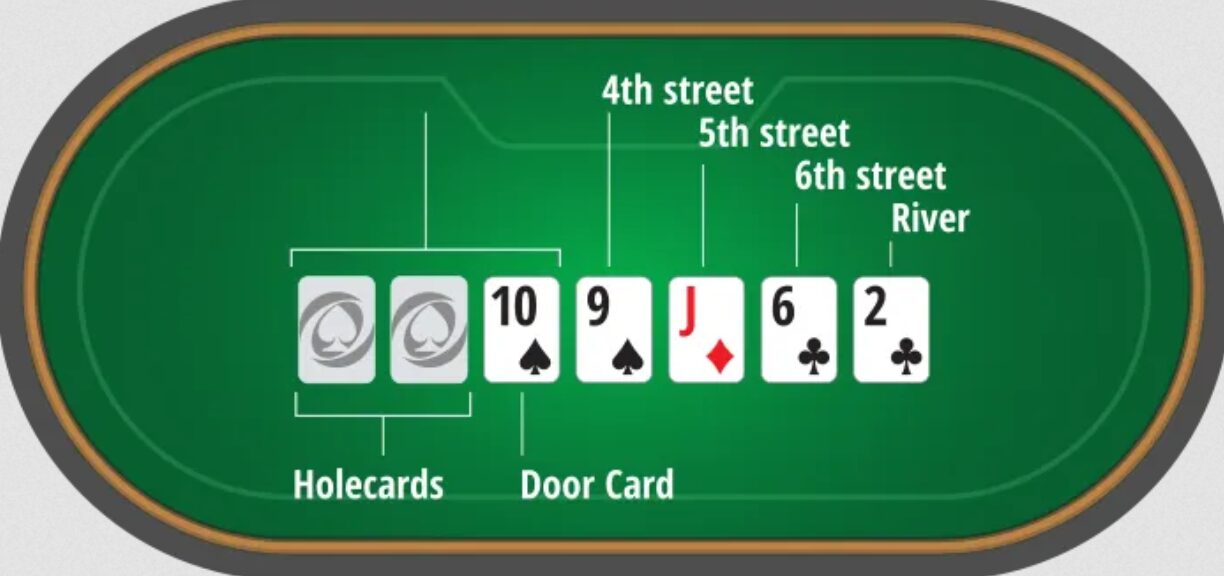
Each player is then dealt three cards: two face-down (hole cards) and one face-up (door card).
2. Third Street (First Betting Round)
The player with the lowest-ranking door card must post a forced “bring-in” bet—typically half the small bet (e.g., $5 in a $10/$20 game). This player acts first.
Other players may:
– Call the bring-in
– Complete to the full small bet (e.g., raise to $10)
– Raise further if completed
After this round, betting proceeds clockwise, with the player who made the last aggressive action acting last on future streets.
3. Fourth, Fifth, and Sixth Streets
On each of the next three rounds, every active player receives one additional face-up card, followed by a betting round:
- Fourth Street: 1 upcard → small bet
- Fifth Street: 1 upcard → big bet
- Sixth Street: 1 upcard → big bet
On Fourth Street and beyond, the player with the lowest visible hand acts first—but if someone has a pair showing, they may open for the big bet in some variants (known as “pairs play”). In most modern games, however, betting limits are fixed: small bets on third and fourth street, big bets from fifth onward.
4. Seventh Street (River)
Each remaining player receives a seventh and final card face-down. A final betting round follows at the big bet level.
If the deck runs out (common in 8-handed games), the dealer uses burn cards to complete the deal, or deals the last card face-up to all players.
Hand Evaluation and Showdown
At showdown, each player constructs the best possible 5-card hand from their 7 cards. There is no “low” version unless explicitly declared (e.g., Stud Hi-Lo). Standard poker hand rankings apply:
- Royal Flush
- Straight Flush
- Four of a Kind
- Full House
- Flush
- Straight
- Three of a Kind
- Two Pair
- One Pair
- High Card
If two players have the same hand (e.g., both have two pair, Aces and Fours), the highest kicker determines the winner. If all five cards are identical, the pot is split.
Key Strategic Principles
1. Start with Strong Door Cards
Your first visible card heavily influences your range and opponents’ perception. Ideal starting conditions include:
– A pair in the hole or showing
– Three high cards with suited or connected potential
– A high door card (Ace through Ten) when opponents show low
Avoid playing weak door cards (e.g., 7 or lower) unless you have a strong hidden pair or connected suited cards.
2. Track “Dead” Cards
Because up to 42 cards can be visible by sixth street, card removal is critical. If three Aces are already out, your hidden pair of Aces is far less valuable. Similarly, if you’re drawing to a flush but four of your suit are visible, your draw is likely dead.
This memory-intensive aspect makes Stud a true test of focus—similar in spirit to Razz, but with opposite hand goals.
3. Bet for Value, Not Bluff
Bluffing is less effective in Stud than in Hold’em due to transparency. With up to 6 cards exposed per opponent, it’s often clear who’s strong and who’s weak. Instead, prioritize value betting with strong hands and folding when clearly beaten.
That said, semi-bluffing with three to a straight or flush on early streets can work—especially if your door card looks threatening.
Common Beginner Mistakes
- Playing any face card without backup: A lone King showing with two low offsuit hole cards rarely improves to a winning hand.
- Ignoring dead cards: Chasing a flush when four of your suit are already visible is a classic leak.
- Overvaluing small pairs: A pair of Fives showing is often dominated by hidden overpairs or stronger draws.
- Failing to adjust to betting limits: Betting the big bet on fourth street is illegal in fixed-limit Stud—always respect the structure.
- Misreading opponents’ strength: A player showing 8-9-T may have a straight draw or already made a straight—adjust accordingly.
Seven-Card Stud vs. Other Stud Variants
- Five-Card Stud: Simpler and faster, but less strategic. Each player gets only 5 cards (1 down, 4 up). Rarely played today.
- Razz: The lowball version of Seven-Card Stud, where the lowest hand wins. Shares dealing structure but inverts strategy.
- Stud Hi-Lo (8-or-Better): Splits the pot between the best high hand and best qualifying low hand (8 or lower).
Seven-Card Stud (high only) remains the purest form—rewarding patience, observation, and hand construction without split-pot complications.
Where to Play Seven-Card Stud
While no longer a mainstream tournament game, Stud thrives in mixed-game cash formats. Online, look for it on GGPoker in HORSE or Stud-only tables. Live casinos with mixed-game “rotation” tables often include Stud as part of their lineup.
It’s also a staple in home games among advanced players who appreciate its strategic depth and lack of “all-in luck” common in Hold’em.
Advanced Tips for Profitable Play
- Steal antes when possible: If you have a high door card and opponents show weak, raise to pick up the dead money.
- Protect strong hands early: If you flop a hidden set on third street, raise to build the pot and reduce opponents.
- Fold aggressively when behind: Unlike in Hold’em’s later streets, you rarely “catch up” in Stud—cut losses early.
- Use blockers strategically: Holding an Ace reduces the chance opponents have strong Aces-up hands—use this in betting decisions.
Conclusion: Master the Classic Game
Seven-Card Stud may not dominate the poker world today, but it remains a cornerstone of strategic poker play and a fixture in high-level mixed games. Its absence of community cards and blinds creates a pure test of hand reading, memory, and disciplined decision-making.
To start playing well, focus on starting hand selection, dead-card awareness, and value betting. Avoid bluffs unless you have strong fold equity, and always respect the betting limits. With practice, you’ll develop the instincts to exploit weaker players and consistently win pots in this timeless variant.