Badugi is a relatively new variant of draw poker, originating in Asia. What sets Badugi apart is that the lowest hand wins, making it similar to Lowball poker. However, Badugi has its own unique twists compared to other low-hand games. The best hands are made from the lowest, non-repeating cards of four different suits. Hands like these are referred to as “Badugi,” the same as the game’s name.
How to Play Badugi
In Badugi, the hand starts with mandatory blind bets. Like in Texas Hold’em, the player to the left of the button posts the small blind, while the next player clockwise posts the big blind, which is double the small blind.
After the blinds are set, each player receives four cards. The first betting round begins with the player after the big blind, who can either fold, call, or raise. Players who stay in the hand after the initial betting round may choose to exchange any number of their cards for new ones from the deck. The goal is to improve their hand by discarding weaker cards and drawing others. Players can swap anywhere from 0 to all 4 of their cards.
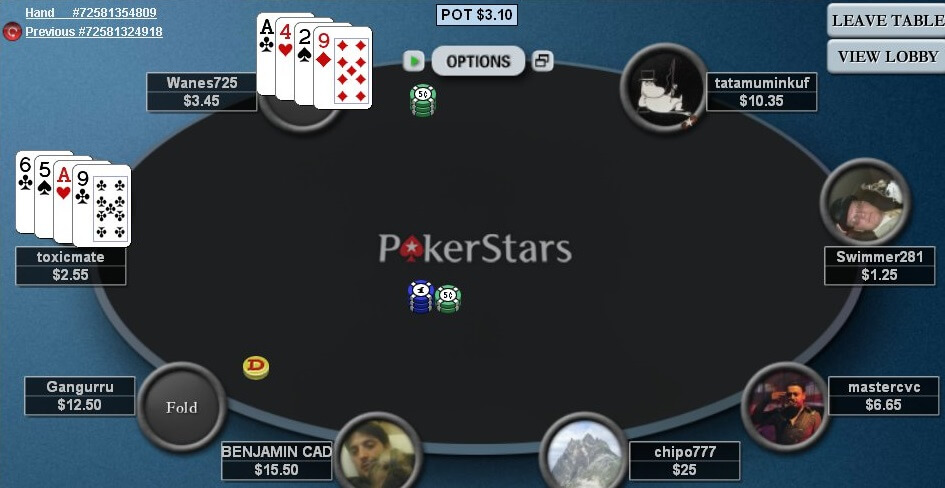
The second betting round starts with the first player remaining in the hand after the dealer, allowing the same actions as before. If players prefer not to raise, they can check and then proceed to a second and final card exchange. After this, a final betting round occurs, and the remaining players reveal their hands to determine the winner.
Badugi Hand Rankings
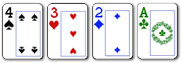
The main objective in Badugi is to form the strongest hand, ideally looking like this: A♠ 2♣ 3♥ 4♦. This means the “nuts” (strongest hand) in Badugi includes four cards of the lowest values, all different in rank and suit. Straights do not count here. The strength of hands made from unique-suited cards is ranked by the highest card within them. The hand with the lowest high card wins. For example, a suited 8 7 6 5 loses to an unsuited 7 4 3 2. These hands are referred to by their highest card, like “8 Badugi” or “7 Badugi.” When two hands have the same high card, the next highest card determines the winner.
If no player has a four-card Badugi hand, the pot goes to the player with the strongest 3-card, 2-card, or even 1-card hand. For instance, if a hand includes two hearts (6♥ 4♥ 3♣ A♠), the higher heart (6♥) is ignored, forming a 3-card hand (4♥ 3♣ A♠) that would lose to any 4-card Badugi hand. The same rule applies to paired cards; for example, 2♠ 2♥ 2♦ 4♣ would count as only two cards: 2 and 4.
Here’s a breakdown of Badugi hands by rank, from weakest to strongest:
- All four cards are of the same suit; only the lowest card counts.
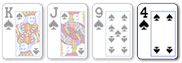
- All four cards are of the same rank; only one card counts.
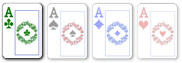
- Three cards are of the same rank; two non-matching cards are used.
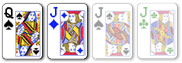
- Only two suits are present, so two suited cards are ignored, leaving two unique-suited cards.
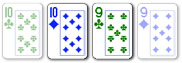
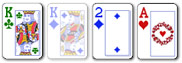
- Two cards share the same suit, creating a 3-card hand.
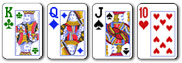
- The weakest 4-card Badugi hand with the highest unique ranks.
- The strongest Badugi hand with the lowest ranks.
Strategy for Playing Badugi
Badugi requires a different approach compared to Texas Hold’em or Omaha. Position matters greatly, as the last player to act can gauge the strength of opponents’ hands based on the number of cards they exchanged. This also affects bluffing: by not exchanging any cards in the first round, you can suggest to opponents that you might already have a strong Badugi hand.