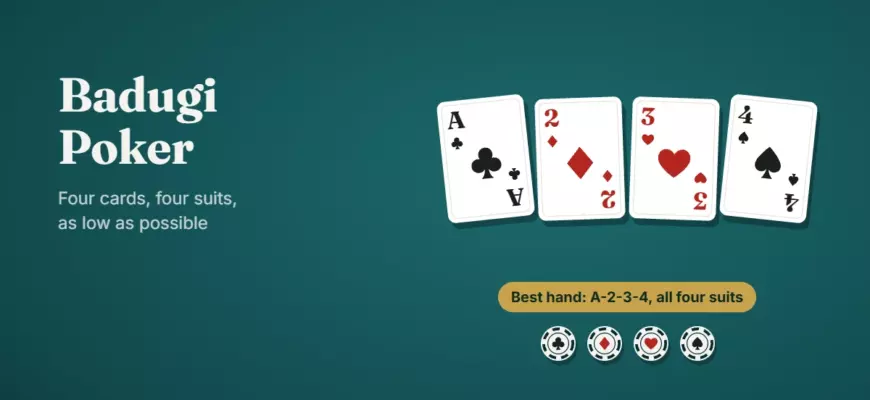
Badugi throws out almost everything you know about poker. The lowest hand wins, not the highest. Pairs hurt you. Matching suits hurt you too. The dream hand isn’t a flush or a full house — it’s four cards of four different suits and four different ranks, as low as possible, with the very best being A♠ 2♥ 3♦ 4♣.
It’s a four-card draw game with no community cards, played across three draws and four rounds of betting. Badugi began in Asia and now runs in high-stakes mixed games and even at the World Series of Poker, rewarding patience, position, and a sharp read on how many cards your opponents swap. This guide covers what actually makes a “badugi,” how the hands rank, how often you’ll make one, the full order of play, and the two plays — snowing and breaking a badugi — that separate winning players from beginners.
- What makes a “badugi” — and why pairs and suits hurt
- Badugi hand rankings, from best to worst
- How often you actually make a badugi
- How a hand of Badugi plays out
- Betting, limits, and using your position
- Reading opponents by how many cards they draw
- Snowing and breaking a badugi
- Starting hands and a few do’s and don’ts
- Where Badugi fits
What makes a “badugi” — and why pairs and suits hurt
A badugi is four cards with no repeated rank and no repeated suit. That’s the target: four different ranks, four different suits, as low as you can get them. Aces are low, which makes them your most powerful card.
Here’s the twist that catches newcomers out. A pair, or two cards of the same suit, doesn’t just fail to help — it actively shrinks your hand. When you hold a duplicate rank or a duplicate suit, one of those cards stops counting, dropping you from a four-card badugi to a weaker three-card hand. The low, scattered, mismatched cards that would be junk in Hold’em are exactly what you want here.
Straights count for nothing in Badugi, and they don’t hurt you either. A hand like 4♠ 3♥ 2♦ A♣ is a perfect, unbeatable badugi even though the ranks run in sequence — the only things that matter are duplicate ranks and duplicate suits.
Badugi hand rankings, from best to worst
Badugi hands fall into four tiers, and the rule between them is absolute: more counting cards always beats fewer, whatever the values. A four-card badugi beats any three-card hand. A three-card hand beats any two-card hand. A two-card hand beats a lone one-card hand — every time.
| Tier | What it is | Beats |
|---|---|---|
| Four-card badugi | Four different ranks, four different suits | Everything below it |
| Three-card hand | One duplicate (rank or suit) discounted | All two- and one-card hands |
| Two-card hand | Two duplicates discounted | One-card hands only |
| One-card hand | Three cards discounted | Nothing |
Within a tier, the lowest high card wins. An 8-high badugi (an “8-badugi”) loses to a 7-badugi; when two hands share the same high card, you compare the next card down, and so on. Suits carry no value of their own, so two players with identical ranks split the pot.
Reading your own hand is the skill to nail first. Say you’re dealt 6♥ 4♥ 3♣ A♠. You hold two hearts, so one of them — the higher 6♥ — is discounted, leaving a three-card hand of 4♥ 3♣ A♠. It’s a solid three-card holding, but any completed four-card badugi beats it.
Does a lower badugi always beat a higher one? Yes. Once both players hold a full four-card badugi, the winner is simply whoever has the lower high card. A-2-3-4 is the “nuts” because no badugi has a top card lower than a four.
How often you actually make a badugi
The suit-and-rank rule makes a complete badugi harder to hit than beginners expect, and knowing the odds keeps you from falling in love with a hand that isn’t there yet. Off the deal, you’ll be handed a finished four-card badugi only about 6% of the time — roughly one hand in sixteen. The other fifteen times out of sixteen, you’re drawing.
Completing a three-card hand is no formality either. When you’re one card short — three suits, three ranks — only around ten cards finish the job: the cards of your missing suit that don’t pair a rank you already hold. That’s about a one-in-five shot on any single draw. The saving grace is that you get up to three draws, so a solid three-card start turns into a badugi a little more than half the time. Making a low one, though — the kind that actually wins — is the real hurdle, which is why starting low matters far more than starting complete.
How a hand of Badugi plays out
Badugi is a triple-draw game: three chances to swap cards, wrapped in four rounds of betting. If you’ve played any draw poker, the rhythm feels familiar — there’s just more of it.
A small blind and big blind seed the pot, exactly as in Hold’em. Each player then receives four cards face down, and the action runs like this:
- First betting round. Starting left of the big blind, players fold, call, or raise.
- First draw. Each remaining player discards 0 to 4 cards and draws replacements.
- Second betting round, then the second draw.
- Third betting round, then the third and final draw.
- Fourth betting round, then showdown — the lowest badugi takes the pot.
You can also win at any point by betting enough that everyone else folds, which happens more than you’d think in a game where most hands never complete.
Betting, limits, and using your position
Badugi is a fixed-limit game at heart. Bets come in set sizes — the small bet in the first two rounds, the big bet, double it, in the last two — and raises are capped, usually at three or four per round. That keeps pots controlled and rewards steady, disciplined play over wild aggression. Pot-limit versions turn up occasionally, but fixed-limit is the standard you’ll meet in mixed rotations.
Inside that framework, position is your biggest lever. You act in the same order every round, so a late seat lets you watch how many cards each opponent draws — across all three draws — before you commit a chip. From late position you can value-bet a low made badugi with confidence and fold a rough hand cheaply; from early seats, you’re guessing. It’s the same reason the button is gold in every game, amplified here by the extra information each draw leaks.
Reading opponents by how many cards they draw
Because there are no shared cards, the number an opponent draws is a live tell — one Hold’em never hands you. A player who stands pat (draws none) usually sits on a made badugi. Someone drawing one card is typically working a three-card hand, hunting the card that completes it. Two or three cards drawn signals a weak, unformed hand.
Position turns that information into money. Acting last, you watch every draw before you decide, which is why the seats near the button are worth so much here. Follow the draws across all three rounds and you’ll often know roughly where you stand before a single card is shown. It’s the same edge that position gives you in every game, sharpened by the draw counts.
Watch the draws, not just the bets. Someone who drew two cards on the first round and then stood pat has probably made a badugi — give it respect. A player who keeps drawing to the end rarely has anything by showdown.
Snowing and breaking a badugi
Two plays define good Badugi, and both grow from the fact that opponents read your draws as closely as you read theirs.
Snowing is the game’s classic bluff. You stand pat on a hand that’s actually junk, representing a made badugi you don’t have, and bet as though you’re holding it. Against players who track draws, declining to draw tells a convincing story, and they may fold better hands. It runs on the same instincts as any good bluff, so save it for observant opponents and use it rarely — snow the same player twice and they’ll simply call you down.
Breaking a badugi is the opposite decision. You already hold a completed badugi, but it’s a rough one, so you throw the high card back and draw for a lower one. Say you hold K♠ 6♥ 4♣ 2♦ — a real four-card badugi, but king-high, which loses to any lower badugi. From late position you’d often discard the K♠ and draw, hoping to swap the king for a low spade; land a 3♠ and your king-badugi becomes 6-4-3-2, a hand that wins almost every pot it enters. Giving up a made hand feels wrong, but late against a strong-looking opponent, breaking a weak badugi for a much lower one is frequently the right call.
Starting hands and a few do’s and don’ts
Discipline before the first draw keeps you out of trouble. Play tight: enter with strong three-card lows that draw to a good badugi — three unpaired, unsuited cards of eight or lower — and, best of all, a made badugi that’s already low. Rough, high, or duplicated starting cards belong in the muck, since the blinds will punish you for defending them with hands that need three clean draws. Boiled down, the habits that matter most:
✅ Enter with low three-card draws (eight-high or better) and made low badugis.
❌ Don’t chase a badugi by drawing two or three cards past the first round.
✅ Use your position to read how many cards opponents draw before you act.
❌ Don’t break a strong, low badugi — you already hold the goods.
✅ Snow occasionally, and only against players who genuinely watch draws.
❌ Don’t snow the same opponent twice in a session; they’ll call you down.
Where Badugi fits
Badugi rarely runs on its own. It lives in mixed-game rotations, where the format changes hand to hand and versatility is the entire point. It has also spawned split-pot hybrids: Badeucy pairs it with 2-7 triple draw, and Badacy pairs it with A-5 triple draw, with the pot shared between the best badugi and the best lowball hand. And it now has its own bracelet events at the World Series of Poker.
If the draw-and-lowball world appeals, its relatives are worth learning. Lowball shares the “lowest hand wins” goal without the suit rule, 5-card draw is the gentlest way into draw poker, and mixed formats like HORSE string several disciplines together. Get Badugi’s upside-down logic down, and the rest of the low-hand family comes far more easily.