
Texas Hold’em is the most popular poker variant in the world, and its rules are simple enough to pick up in a few minutes. Each player gets two private hole cards, five community cards are dealt face-up over the course of the hand, and you make the best five-card hand from any mix of those seven. You win either by holding the strongest hand at showdown or by betting hard enough that everyone else folds.
The whole game runs on one loop. A dealer button marks who acts last, the two players to its left post forced bets called blinds, and betting then moves through four rounds — preflop, flop, turn, and river — with community cards revealed along the way. If two or more players are left after the river, the hands are shown and the best one takes the pot.
That is the shape of every hand — and whether it’s your first freeroll or a mid-stakes cash game, one misread rule can cost you a pot. The rest of this guide walks each street in order, spells out every action, lists the hand rankings, and clears up the rules that trip up new players.
- The Table, the Button, and the Blinds
- The Four Betting Rounds
- Preflop: hole cards and the first bets
- The flop: the first three community cards
- The turn: fourth street
- The river: the final card
- The Showdown and Who Wins
- The Actions You Can Take
- No-Limit, Pot-Limit, and Limit
- Special Situations and Edge Cases
- What happens if a card is exposed?
- Running it twice
- Dealing errors and mucked hands
- Common Rule Misconceptions
- A Sample Hand, Start to Finish
- Before You Play
The Table, the Button, and the Blinds
A Hold’em table seats 2 to 10 players and uses a standard 52-card deck with no jokers. Play revolves around the dealer button, a marker that shows who acts last after the flop and moves one seat clockwise after every hand.
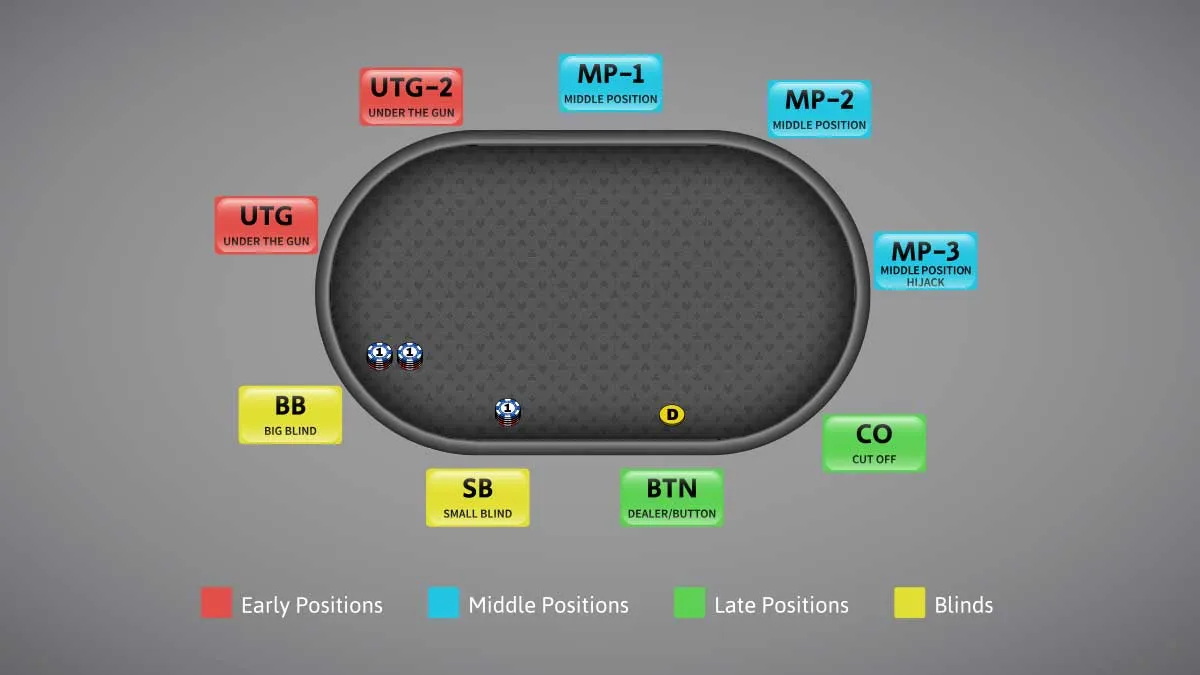
The two players to the left of the button post forced bets called blinds, which build the first pot and guarantee there is something to play for:
- Small blind (SB) — posted by the player immediately left of the button.
- Big blind (BB) — posted by the next player along, and equal to the minimum bet. In a $1/$2 game the small blind is $1 and the big blind is $2.
For the strategic side of these seats, see our breakdown of what blinds are in poker.
Online, the button always advances to the next active player after each hand, skipping empty seats automatically. Live tournaments sometimes use a “dead button” that can sit on an empty seat for a hand — but on any online site, it simply moves on.
The Four Betting Rounds
Every hand plays out over four betting rounds, with new community cards dealt between them. Here is the sequence at a glance:
| Round | Cards on the board | Action starts with |
|---|---|---|
| Preflop | None | Player left of the big blind (under the gun) |
| Flop | 3 cards | First active player left of the button |
| Turn | 4 cards | First active player left of the button |
| River | 5 cards | First active player left of the button |
Preflop: hole cards and the first bets
Each player is dealt two private cards face down. Betting starts with the player to the left of the big blind — the seat known as under the gun — who can fold, call the big blind, or raise. Action moves around the table, and the big blind acts last preflop, with the option to check if no one has raised.
The flop: the first three community cards
The dealer puts three cards face up in the middle — the flop — and a fresh betting round starts with the first active player left of the button. With no bet in front of them, players can check or bet; once someone bets, the others call, raise, or fold. This is where reading the board begins; for how textures change a hand, see our guide to the flop as a key stage of the game.
The turn: fourth street
A fourth community card, the turn, is dealt, and another betting round follows in the same order. Bets often grow here, especially in No-Limit.
Your maximum bet depends on the format. In No-Limit you can bet anything from the minimum up to your entire stack; in Pot-Limit your biggest legal bet is the current size of the pot.
The river: the final card
The fifth and last community card, the river, is dealt, and the final betting round runs by the same rules. Once it is complete, any remaining players go to showdown. For value betting and bluffing on the biggest streets, see how to play the toughest streets.
The Showdown and Who Wins
If two or more players are still in after the river betting, the hands are revealed and the best five-card hand — made from any mix of your two hole cards and the five on the board — wins the pot. If everyone folds to a bet at any point, the last player standing wins without showing anything.
A few showdown rules save arguments:
- You build a five-card hand from any combination — both hole cards, one, or even none if the board plays best.
- Whoever made the last bet or raise on the river shows first; if the river was checked through, the first active player left of the button shows first.
- At many sites and cardrooms you must table both hole cards to claim the pot, even if only one plays. If hands tie, the pot is split evenly.
Mucking your hand at showdown gives up your claim to the pot — even if you were holding the winner. If you are not certain, turn your cards over rather than releasing them.
The hand rankings, strongest to weakest:
| Rank | Hand | Example |
|---|---|---|
| 1 | Royal Flush | A♠ K♠ Q♠ J♠ T♠ |
| 2 | Straight Flush | 9♥ 8♥ 7♥ 6♥ 5♥ |
| 3 | Four of a Kind | Q♠ Q♥ Q♦ Q♣ 4♠ |
| 4 | Full House | J♠ J♥ J♦ 8♣ 8♠ |
| 5 | Flush | A♣ J♣ 8♣ 5♣ 2♣ |
| 6 | Straight | 7♦ 6♠ 5♥ 4♣ 3♦ |
| 7 | Three of a Kind | 8♠ 8♥ 8♦ K♣ 4♠ |
| 8 | Two Pair | A♠ A♣ 9♥ 9♦ 5♠ |
| 9 | One Pair | T♠ T♦ K♣ 7♥ 3♠ |
| 10 | High Card | A♦ J♠ 8♥ 5♣ 2♦ |

For worked examples of each, see our full breakdown of Texas Hold’em hand rankings.
The Actions You Can Take
Every decision in Hold’em comes down to a short list of actions:
- Check — pass without betting, only when no one has bet yet this round. Covered in detail in what “check” means in poker.
- Bet — put the first wager into the round, at least the size of the big blind.
- Call — match the current bet to stay in the hand.
- Raise — increase the bet; a raise must be at least as large as the previous bet or raise.
- Fold — give up your hand and any claim to the pot.
- All-in — commit all your remaining chips. If opponents have more chips behind, a side pot is created for the extra.
Saying “call” and then trying to raise is a binding call in most regulated games — the string-raise doesn’t stand. Declare your action clearly and in one go.
No-Limit, Pot-Limit, and Limit
The core rules never change, but the cap on bet sizes reshapes how the game plays:
| Structure | Maximum bet | What it rewards |
|---|---|---|
| No-Limit (NLHE) | Anything up to your whole stack | Aggression and well-timed bluffs; the most common format online |
| Pot-Limit (PL) | The current size of the pot | Big but capped pots; seen mostly in some European cash games |
| Limit | Fixed bets and raises (e.g. $2 preflop and flop, $4 turn and river) | Pot odds and patience over big swings |
No-Limit favours aggression and bluffing, and most online sites, including GGPoker, run it as the default.
Special Situations and Edge Cases
What happens if a card is exposed?
If the dealer flashes a card while dealing preflop, it becomes a dead card and is replaced, and the deal continues. Once the community cards are out, misdeals are rare; an exposed card there usually stands unless several errors pile up.
Running it twice
In cash games, players who are all-in can agree to run it twice to smooth out variance — the remaining board is dealt two times and the pot is split according to the two results. Tournaments don’t allow it.
Dealing errors and mucked hands
Once you fold before showdown, your hand is dead, even if you tossed it by accident, so never fling cards toward the muck unless you are sure.
Protect your hand by resting a chip on top of your cards. An unprotected hand can be swept into the muck by a dealer’s mistake, and you have little recourse once it is.
Common Rule Misconceptions
A few beliefs cost beginners pots:
- “You must use both hole cards.” False — you can play the board. If it runs A♠ K♠ Q♠ J♠ T♠, everyone shares a royal flush.
- “The dealer decides who wins.” False. The dealer or software only reads the hands; the cards alone decide the pot.
- “You can flash one card to prove your hand.” Risky — in most venues, showing one card either counts as a fold or forces you to reveal the whole hand.
Poker isn’t only about the cards you’re dealt — it’s about playing the rules, and your opponents, better than they play you.
A Sample Hand, Start to Finish
Here is how the pieces fit together at a six-handed $1/$2 table, with the button on Player 1:
- Blinds. Player 2 posts the $1 small blind, Player 3 the $2 big blind.
- Preflop. Player 4 raises to $6. Players 5 and 6 fold, Player 1 calls, the small blind folds, and the big blind calls.
- Flop (Q♦ 8♠ 3♣). The big blind checks, Player 1 bets $10, the big blind folds, Player 4 calls.
- Turn (2♥). Player 1 bets $25, Player 4 calls.
- River (A♠). Player 1 bets $60, Player 4 folds.
- Result. Player 1 wins the pot without showing — the opponent folded, so there is no showdown.
Notice that Player 1 never had to reveal a hand: position, steady betting, and a well-timed river bet won it outright.
Before You Play
House rules shift slightly between live casinos and online sites, so it is worth checking the specific terms wherever you play. On a site like GGPoker the rules are standardised and enforced automatically, but knowing them yourself prevents costly mistakes and lets you act with confidence. A grasp of equity then helps you turn those rules into mathematically sound decisions.
Walk through each street in your head before you act, and before long the rules fade into the background — leaving you free to focus on what actually wins money: outplaying the people across the table.


